
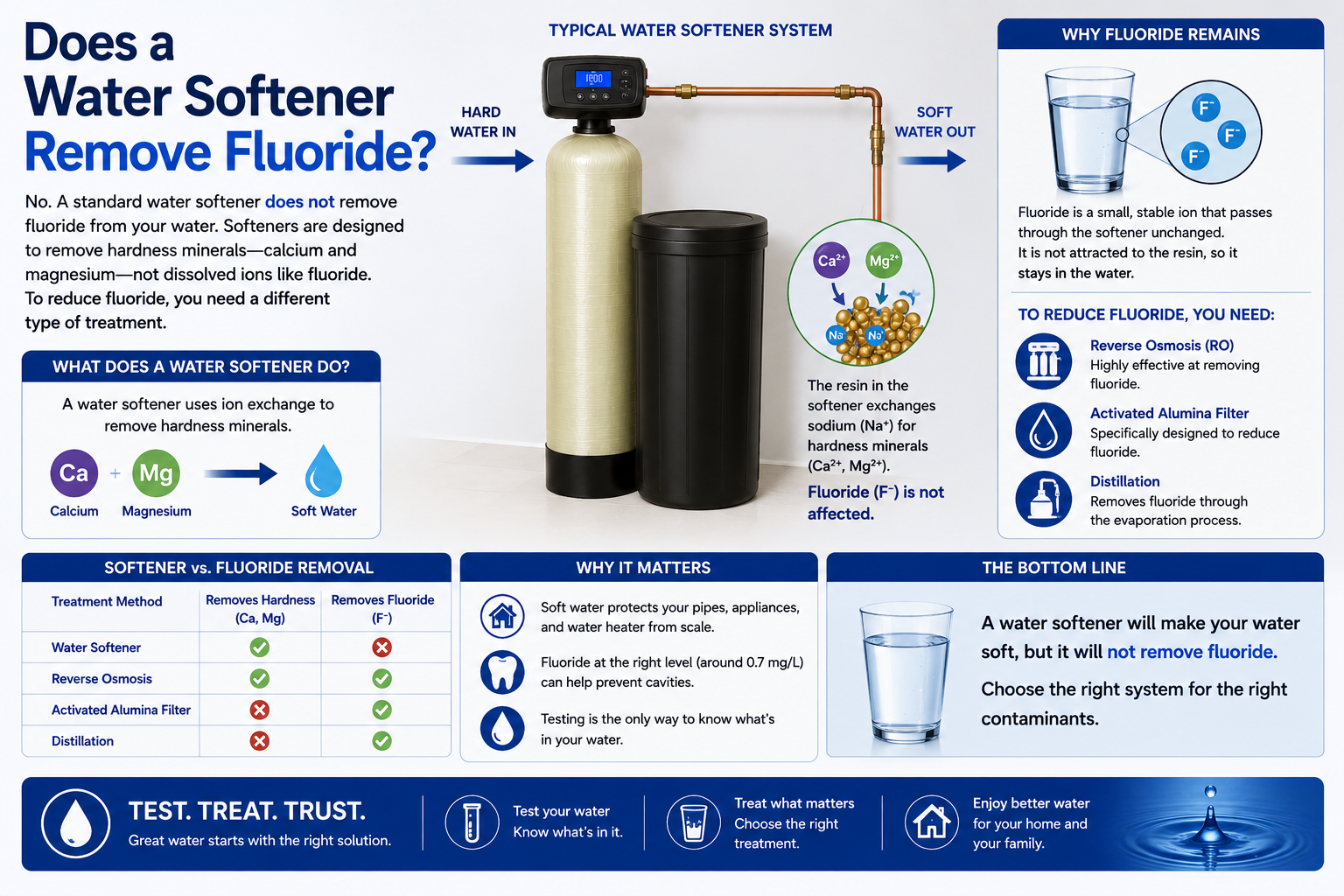
Whether you're trying to reduce your fluoride intake or trying to make sure you're still getting fluoride's dental benefits after installing a water softener, this is a question worth getting a clear answer to. The short answer is no — a water softener does not remove fluoride. Understanding why, and what actually does remove it, helps you make informed decisions about your water treatment setup.
Why a Water Softener Doesn't Remove Fluoride
A water softener works through ion exchange — a process specifically designed to remove positively charged ions (cations), primarily calcium and magnesium. As covered in our article on how ion exchange water softening works, the resin beads inside a softener are covered with negatively charged sites that attract and hold positively charged calcium and magnesium ions, exchanging them for sodium.
Fluoride, however, exists in water as a negatively charged ion — a fluoride anion (F⁻). Since the resin in a standard water softener is designed to attract and exchange cations (positively charged ions), it has essentially no mechanism for capturing or removing fluoride, which is an anion. Fluoride passes through a water softener's resin bed completely unaffected, exiting in the treated water at the same concentration it entered.
This is a fundamental limitation of the ion exchange chemistry involved — not a design flaw or a matter of an inferior system. Cation exchange softeners are simply not built to interact with anions like fluoride.
Where Does Fluoride in Your Water Come From?
For Florida homeowners on municipal water, fluoride is typically present because it's intentionally added by the water utility. Community water fluoridation has been a public health practice in the United States since the 1940s, added at controlled levels to help reduce tooth decay, particularly in children.
The recommended fluoridation level set by the U.S. Public Health Service is 0.7 milligrams per liter (mg/L) — a level determined to provide dental benefits while minimizing the risk of dental fluorosis (a cosmetic condition affecting tooth enamel appearance).
Not every Florida municipality fluoridates its water, and fluoridation practices are subject to local decision-making and, increasingly, public debate. If you're unsure whether your municipal water is fluoridated, your utility's annual water quality report will indicate current fluoride levels.
For well water users, fluoride can also occur naturally, though usually at lower concentrations than intentionally fluoridated municipal water. Natural fluoride levels vary by geology and location.
Why This Matters for Different Households
The question of fluoride removal matters differently depending on what you're trying to achieve.
If you want fluoride's dental benefits preserved: Good news — since a water softener doesn't remove fluoride, softening your water has no effect on fluoride's presence or dental benefit. Your softened water retains the same fluoride concentration as your source water. No additional action is needed if fluoride retention is your goal.
If you're trying to reduce or eliminate fluoride intake: A water softener alone will not accomplish this. Some households — for various personal, medical, or philosophical reasons — prefer to minimize their fluoride exposure from drinking water. If this describes your situation, a different treatment approach is needed specifically to address fluoride.
What Actually Removes Fluoride
If reducing fluoride is a goal, a few specific treatment technologies are effective:
Reverse osmosis. RO is one of the most effective consumer-level treatments for fluoride removal, typically reducing fluoride by 85 to 92 percent or more, depending on the membrane and system configuration. As covered in our article on how reverse osmosis works, the RO membrane's extremely small pore size rejects fluoride ions along with a broad range of other dissolved substances. An under-sink RO system is the most practical and comprehensive solution for households wanting to reduce fluoride in their drinking water.
Activated alumina filtration. A specialized filter media specifically effective at removing fluoride through adsorption. Activated alumina is sometimes used in dedicated fluoride-removal filters, particularly for well water with naturally elevated fluoride. It's less commonly used than RO for whole-system fluoride reduction but is an option for specific applications.
Distillation. Distillation — boiling water and collecting the condensed steam — removes fluoride effectively since fluoride doesn't evaporate with the water vapor. This is not a practical whole-house solution but can be used for producing small quantities of fluoride-free water.
Bone char carbon. A specific type of carbon media (different from standard activated carbon) that has some effectiveness for fluoride removal, though less commonly used in residential systems compared to RO.
Standard activated carbon filtration — the kind used in most pitcher filters, refrigerator filters, and standard whole-house carbon systems — is not effective at removing fluoride. As covered in our article on how carbon filtration works, standard carbon removes contaminants through adsorption, and fluoride does not adsorb effectively to standard activated carbon media.
What a Complete Florida Home Water Treatment System Looks Like With Fluoride Considerations
For most Florida homeowners, the standard treatment approach — a whole-house water softener for hardness and a whole-house carbon filter for chlorine or chloramines — leaves fluoride unaffected in the water throughout the home. This is expected and, for most households, not a concern.
For households specifically wanting to reduce fluoride in their drinking and cooking water, adding an under-sink reverse osmosis system addresses this alongside its broader purification benefits — removing fluoride, sodium from the softener, nitrates, heavy metals, and other dissolved contaminants, all from the water used for drinking and cooking specifically.
This layered approach means whole-house water is treated for hardness and chemical disinfectants, while drinking water receives the additional purification — including fluoride reduction — that RO provides.
A Note on Fluoride and Health
Community water fluoridation remains a topic of ongoing public health discussion, with established dental health benefits on one side and questions about optimal exposure levels raised in various contexts on the other. This article isn't intended to take a position on that broader public health question — it's intended to clarify the water treatment chemistry: what a softener does and doesn't do regarding fluoride, and what treatment options exist for households that want to address fluoride levels for whatever reason.
If you have specific health questions about fluoride intake, your dentist or physician is the appropriate resource for personalized guidance based on your family's specific needs and circumstances.
The Bottom Line
A water softener removes calcium and magnesium — not fluoride. The ion exchange chemistry that makes softening effective for hardness has no mechanism for removing fluoride, which exists in water as a differently charged ion entirely. If fluoride retention is your goal, a softener changes nothing about your water's fluoride content. If fluoride reduction is your goal, reverse osmosis is the most practical and effective solution for most Florida households.
Have questions about fluoride, water softening, or reverse osmosis for your Florida home? Dependable Water Treatment can help you understand what's in your water and design a treatment system that addresses your specific goals. Contact us to learn more.