If you have a pool in Florida — and a significant number of Florida homeowners do — you're probably focused on chlorine levels, pH balance, and algae prevention. But there's another water quality factor working against your pool that often goes unaddressed: hardness. Filling and topping off your pool with hard water introduces calcium and magnesium that accumulate over time, affecting everything from your pool's appearance to the lifespan of your equipment.
Why Pool Water Hardness Matters
Pool water chemistry is a balancing act. Chlorine levels, pH, alkalinity, and calcium hardness all interact with each other, and getting the balance right keeps your water clear, your equipment protected, and your pool surfaces in good condition. Calcium hardness is one of the core parameters pool professionals test and manage — and it's directly affected by the source water you use to fill and top off your pool.
Florida pools are typically filled with either municipal water or well water — both of which, as covered throughout our Learning Center, tend to be quite hard in most parts of the state. Every time you fill your pool initially, and every time you add water to replace evaporation and splash-out, you're introducing whatever hardness level your source water has.
Unlike your household plumbing, where water flows through and eventually exits, your pool is a large, mostly closed system. The minerals you add don't leave — they stay in the water and, over time, become more concentrated as water evaporates and fresh water with its own mineral load gets added.
What Happens When Pool Calcium Hardness Gets Too High
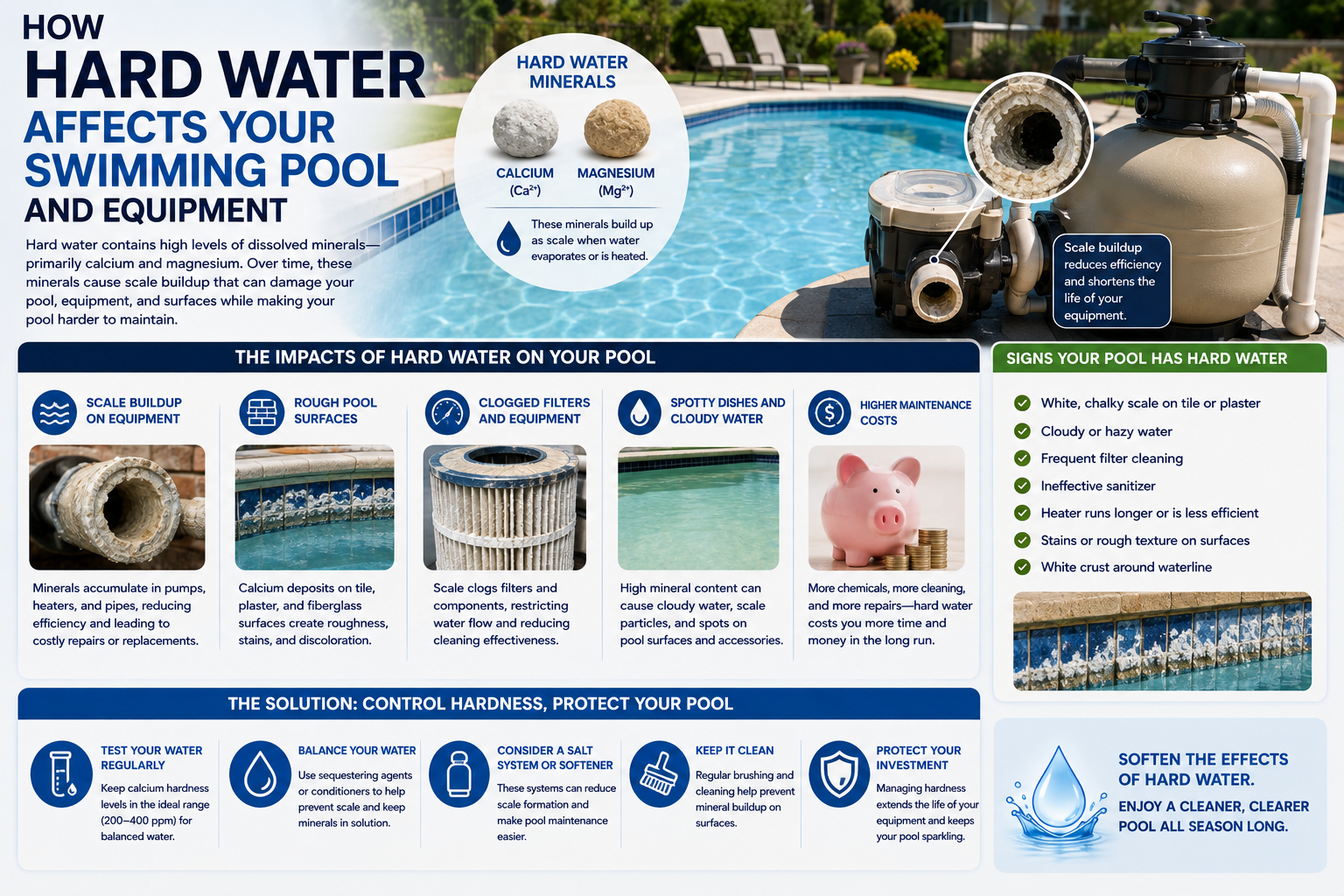
The recommended calcium hardness range for most residential pools is between 200 and 400 parts per million, with the ideal range typically cited as 250 to 350 PPM depending on your pool's surface type. When calcium hardness climbs above this range — which happens readily when pools are filled and topped off with Florida's hard water without any attention to the pool's calcium level — several problems develop.
Cloudy water. Excess calcium can cause water to take on a hazy or cloudy appearance, even when chlorine and pH are properly balanced. This is one of the most common and frustrating pool water clarity issues, and it's often misdiagnosed as a chlorine or filtration problem when the actual cause is calcium hardness.
Scale formation on pool surfaces. Just as hard water forms scale on faucets and fixtures in your home, high-calcium pool water forms scale on pool surfaces — particularly noticeable on tile lines, where a white, chalky, or crusty deposit builds up at the waterline. This scale is difficult to remove and, over time, can permanently etch and discolor tile and grout.
Scale buildup inside pool equipment. This is where the cost really adds up. Calcium scale forms inside your pool pump, filter, heater, and plumbing — the same scaling process that damages your home's water heater and appliances, happening inside your pool equipment instead.
Rough pool surfaces. On plaster and pebble-finish pools, calcium scale can build up on the surface texture itself, creating a rough, abrasive feel that's uncomfortable for swimmers and can be sharp enough to cause minor scrapes.
Reduced sanitizer effectiveness. High calcium levels can interfere with how effectively chlorine sanitizes your pool water, sometimes requiring higher chlorine doses to achieve the same disinfection results — an ongoing cost increase tied directly to unaddressed hardness.
The Equipment Cost: Where Hard Pool Water Really Hurts
Your pool's mechanical equipment — pump, filter, heater, and any automated chemical feed systems — is exposed to the full volume of your pool water continuously. Scale accumulation inside this equipment follows the same principles covered in our article on how hard water damages your water heater, just at pool scale.
Pool heaters are particularly vulnerable. Scale that forms on heat exchanger surfaces insulates them from the water, forcing the heater to work harder and use more energy to reach and maintain your target temperature — exactly the same efficiency loss mechanism that affects a residential water heater. In severe cases, scale buildup can cause heat exchangers to overheat and fail prematurely, since the scale prevents proper heat transfer to the water flowing past it.
Pool pumps experience scale accumulation in the impeller housing and seals, reducing efficiency and increasing wear on seals and bearings, potentially shortening pump lifespan.
Filters — particularly cartridge and DE filters — can become coated with calcium scale that reduces their filtration effectiveness and requires more frequent and more intensive cleaning to maintain proper function.
Automatic chlorinators and salt chlorine generators are especially sensitive to scale. Salt cell chlorine generators, popular in many Florida pools, are particularly prone to calcium scale buildup on the cell plates — reducing chlorine production efficiency and requiring more frequent acid washing of the cell to maintain performance. Severe scaling can shorten a salt cell's lifespan significantly, and salt cells are one of the more expensive components to replace in a saltwater pool system.
Why Florida Pools Are Particularly Vulnerable
Several factors combine to make hard water a bigger issue for Florida pools than for pools in many other parts of the country.
Florida's intense heat and sun drive significant evaporation from outdoor pools — often an inch or more of water lost per week during summer months. Every gallon of evaporated water is replaced with fresh water carrying its own mineral load, while the minerals from the evaporated water remain behind, concentrating over time. This evaporation-and-refill cycle happens far more aggressively in Florida than in cooler climates, meaning Florida pool water can experience calcium concentration increasing faster than pools in less extreme climates.
Additionally, Florida's naturally hard source water — whether from municipal supply or well water — starts pools off at a higher baseline hardness than pools filled with softer water in other regions, giving Florida pool owners less room before hitting problematic calcium levels.
Testing and Managing Pool Calcium Hardness
Pool test kits and test strips typically include calcium hardness as one of the standard parameters, alongside chlorine, pH, and alkalinity. Testing calcium hardness regularly — as part of your normal pool water testing routine — lets you catch rising levels before they become a scaling problem.
If calcium hardness tests high, a partial water replacement — draining some pool water and refilling with lower-hardness water — is the most direct way to bring levels back down, since there's no practical way to remove dissolved calcium from a full pool of water without professional treatment.
Pool-specific scale inhibitor products can help manage calcium in solution and reduce scale formation temporarily, but like water conditioners for household plumbing, they manage symptoms rather than addressing the underlying source water hardness.
The Case for Treating Fill Water
The most effective long-term solution is addressing the hardness of the water going into your pool in the first place — particularly for the initial fill and for significant refills after draining for resurfacing or major maintenance.
Using softened water for pool filling and major top-offs means your pool starts at a much lower baseline hardness, giving you significantly more room before calcium accumulation becomes a problem. This is especially valuable for pools that experience heavy evaporation and frequent top-offs throughout Florida's long pool season.
For homeowners who already have a whole-house water softener installed for their household plumbing, running a hose from an outdoor spigot on the softened side of the system for pool filling and top-offs is a straightforward way to protect pool equipment from the same hardness that would otherwise affect it. As covered in our article on water softener bypass valves, most homeowners actually bypass the softener for large-volume outdoor uses like pool filling to conserve softening capacity — but for pool owners specifically dealing with scale problems, running softened water to the pool on a periodic basis, particularly for major refills, can be a worthwhile trade-off against the cost of equipment damage.
The Bottom Line
Hard water doesn't stop affecting your home at the pool deck — it follows the water into your pool and works on your equipment the same way it works on your water heater and appliances indoors. Florida's combination of naturally hard source water and intense evaporation makes pool calcium management a genuine ongoing consideration, not a one-time concern.
Regular testing, awareness of your fill water's hardness, and consideration of softened water for major fills and top-offs can meaningfully extend the life of your pool equipment and keep your pool surfaces looking their best throughout Florida's long swimming season.
Curious how your household water quality connects to your pool? Dependable Water Treatment helps Florida homeowners understand their water from every angle — indoors and out. Contact us to schedule a water test.