Boiling water is one of those solutions that feels instinctively right. Heat kills germs. Boiling purifies. It's what people have done for centuries when they weren't sure about their water. So it's not surprising that some homeowners assume boiling will also take care of hard water minerals — or at least reduce them significantly.
It doesn't. In fact, for hardness specifically, boiling makes things worse, not better.
The Myth
The assumption is that boiling water — like other forms of purification — removes or reduces the minerals that cause hardness. If you boil your water before using it, you'll have softer, cleaner water with fewer mineral problems.
What Boiling Actually Does to Hard Water
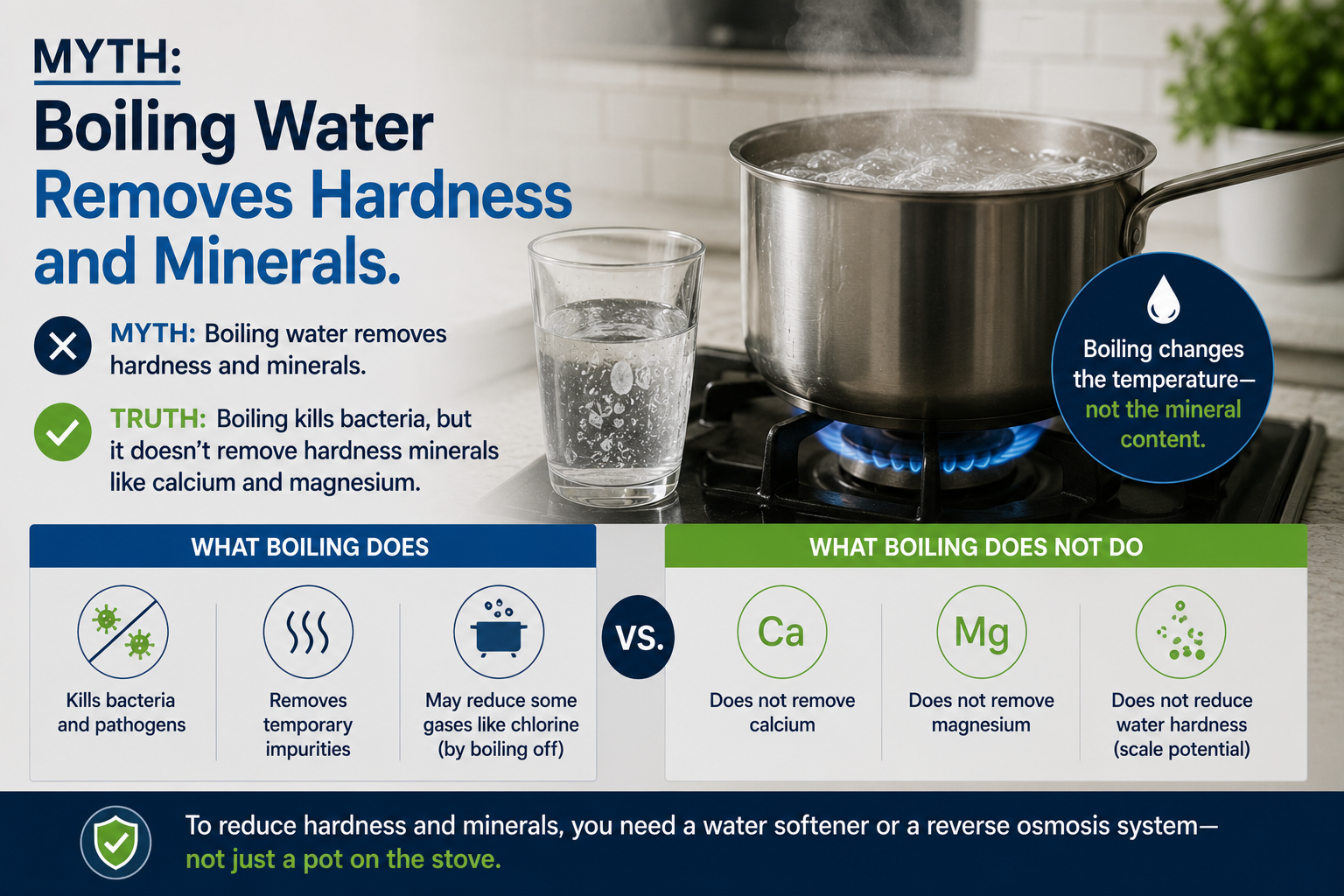
When you boil water, you're driving off dissolved gases and killing biological contaminants — bacteria, viruses, and parasites that can't survive the heat. For biological safety in an emergency situation, boiling is genuinely effective.
But minerals are a completely different matter. Calcium and magnesium — the minerals that cause hardness — are not volatile. They don't evaporate. They don't break down at 212°F. Boiling does absolutely nothing to remove them from the water.
What boiling does do is remove water — through evaporation. And here's where it gets counterproductive: as the water volume decreases through boiling and evaporation, the minerals that were dissolved in that water become more concentrated in the remaining liquid. Boil a pot of hard water long enough, and you end up with water that's harder than when you started.
You can see this process in action every time you boil water in a kettle or pot. The white, chalky residue left on the inside of the pot after the water evaporates is the mineral content that was dissolved in the water — now concentrated and deposited on the surface. Boiling didn't remove the minerals. It demonstrated exactly how much was there.
What About the White Flakes That Appear When You Boil Water?
Some people notice white flakes or particles appearing in their water when they bring it to a boil — and assume this means the boiling is "pulling out" the minerals and that the water is being purified in the process.
This is actually the opposite of purification. Those white flakes are calcium carbonate — a form of the hardness mineral that precipitates out of solution when heated. The mineral is leaving the dissolved state and becoming a visible solid particle. If you then pour off the water and leave the flakes behind, you have removed some hardness — but you've also lost a significant amount of your water to the process, and the water remaining is still quite hard.
This is not a practical or effective method for water softening in any real-world sense.
What Boiling Does and Doesn't Address
To be clear about what boiling is and isn't useful for:
Boiling IS effective for:
- Killing bacteria, viruses, and parasites — making water biologically safe in emergency situations
- Removing some volatile organic compounds that evaporate with the steam
Boiling is NOT effective for:
- Removing hardness minerals (calcium and magnesium)
- Removing nitrates
- Removing heavy metals like lead or arsenic
- Removing chlorine or chloramines effectively (some chlorine may off-gas, but it's inconsistent)
- Removing PFAS or other chemical contaminants
- Any contaminant that doesn't evaporate or break down at boiling temperature
In fact, for non-volatile contaminants like hardness minerals, nitrates, and heavy metals, boiling concentrates them rather than removing them.
Why This Myth Persists
The boiling-as-purification instinct is deeply ingrained — and for biological contamination, it's correct. The leap from "boiling purifies water" to "boiling removes all water problems" is an understandable extension of a true premise into territory where it doesn't apply.
It's also reinforced by the visible effect of scale left in kettles and pots. People see the white residue and think the boiling extracted the minerals from the water — when in reality, the water evaporated and left the minerals behind, concentrated.
What Actually Removes Hardness
For anyone trying to address hard water, the methods that actually work are:
Ion exchange water softening. The only technology that reliably and completely removes hardness minerals from water at a household scale. A water softener exchanges calcium and magnesium ions for sodium ions, producing genuinely soft water throughout your home.
Reverse osmosis. An RO system removes hardness minerals along with a broad range of other dissolved solids. Effective for drinking and cooking water at the point of use, though not practical as a whole-house hardness solution due to flow rate limitations.
Distillation. Boiling water and collecting the steam — which leaves minerals behind — does produce mineral-free water. But the process is slow, energy-intensive, and not practical for whole-house use. A countertop distiller can produce small quantities of mineral-free water, but it's not a household water treatment solution in the practical sense.
Boiling water in a pot and drinking it is none of these things. It doesn't soften. It doesn't purify beyond biological safety. And for hardness specifically, it works in the wrong direction.
The Bottom Line
Boiling is one of humanity's oldest and most effective tools for making water biologically safe. But it has no meaningful effect on hardness — and for the minerals that cause hard water problems, it actually concentrates the problem rather than solving it.
If you've been boiling your Florida water hoping to reduce the hardness, the mineral scale building up inside your kettle is a direct demonstration of why that approach doesn't work. The solution to hard water isn't heat — it's ion exchange, and that means a water softener.
Dependable Water Treatment installs water softeners and whole-house treatment systems for Florida homeowners. If hard water is a problem in your home, contact us for a water test and find out what treatment will actually solve it.