Bottled water has one of the most successful marketing stories in modern consumer history. In a few decades it went from a niche product to a $300 billion global industry — built almost entirely on the perception that bottled water is purer, cleaner, and safer than what comes out of your tap.
That perception is worth examining carefully. Because in many cases — and particularly when your tap water is properly treated — it doesn't hold up.
The Myth
The assumption is simple: bottled water comes from pristine natural springs or advanced purification facilities, is held to rigorous standards, and is measurably cleaner and safer than municipal tap water or home-treated water. The plastic bottle is a symbol of purity.
The reality is considerably more complicated.
Who Regulates What
Here's a fact that surprises most people: tap water and bottled water are regulated by different federal agencies with different standards and different testing requirements — and in several important ways, tap water is held to stricter standards than bottled water.
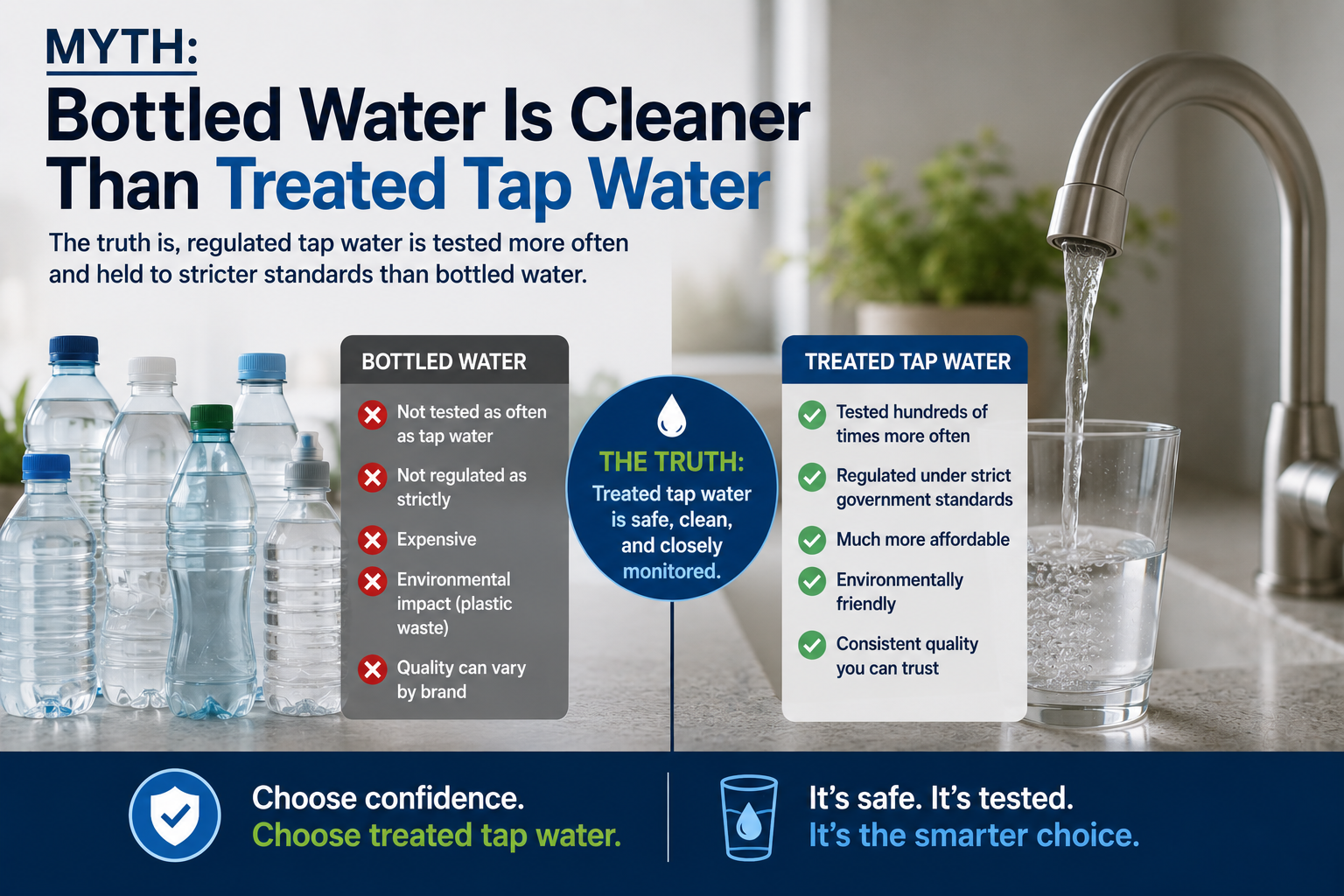
Municipal tap water is regulated by the EPA. Water utilities are required to test their water hundreds of times per month for a broad range of contaminants. They are required to publish annual Consumer Confidence Reports disclosing exactly what was found and at what levels. Violations must be reported to customers promptly. The testing is continuous, the reporting is public, and the accountability is built into the system.
Bottled water is regulated by the FDA as a food product. FDA standards for bottled water are generally similar to — but not stricter than — EPA standards for tap water. Crucially, bottled water companies are not required to test as frequently as municipal utilities, are not required to publish their testing results, and are not subject to the same real-time public disclosure requirements. If a problem is found, the response timeline is slower and less transparent.
In practical terms: you know more about what's in your municipal tap water than you know about what's in most bottled water.
A Significant Percentage of Bottled Water Is Tap Water
Studies and investigations — including a well-known analysis by the Natural Resources Defense Council — have found that a substantial portion of bottled water sold in the United States is simply municipal tap water that has been filtered and repackaged. Major brands including Pepsi's Aquafina and Coca-Cola's Dasani have acknowledged that their source water is public water supplies.
That filtered tap water may go through additional treatment — typically reverse osmosis or carbon filtration — before bottling. But so does the water from an under-sink RO system in your home. The difference is you pay pennies per gallon at home versus dollars per gallon for the bottle.
The Plastic Problem
Bottled water comes in plastic. And plastic is not inert.
Chemicals from plastic packaging — including BPA and related compounds, as well as phthalates — can leach into water over time. The rate of leaching increases with heat and age. In Florida, where water bottles routinely sit in hot cars, warm garages, and sun-exposed storage areas, the conditions for plastic leaching are present on a regular basis.
Beyond leaching, microplastics have been detected in bottled water in multiple studies — tiny plastic particles that enter the water during bottling and from the container itself. The long-term health implications of microplastic ingestion are still being studied, but it's a category of contamination that doesn't exist in properly treated tap water delivered through plumbing.
What Properly Treated Home Water Actually Delivers
When your home has a well-designed water treatment system — a whole-house softener, a carbon filter for chloramines, and an under-sink reverse osmosis system for drinking water — what comes out of your kitchen tap is exceptional quality water by any reasonable measure.
A reverse osmosis system removes:
- Dissolved solids including sodium, nitrates, heavy metals, and fluoride
- PFAS and other emerging contaminants
- Chlorine and chloramines
- Bacteria and some viruses (in combination with appropriate pre-filtration)
- Virtually everything a bottled water plant removes — and often more
The water produced by a home RO system is comparable in purity to the best bottled water on the market. It costs pennies per gallon. It comes in no plastic. And you know exactly what treatment it's received because you chose and installed the system.
The Testing Transparency Gap
One of the strongest arguments for home-treated water over bottled water is transparency. You know what contaminants your treatment system addresses. You can test your treated water independently at any time. You have a water quality report from your utility telling you what's in the source water before treatment.
With bottled water, you have a label with a picture of a mountain and some marketing language. The testing data behind that label is not publicly available in the way municipal water data is.
What This Means for Florida Homeowners
For Florida homeowners dealing with hard water, chloramines, iron, or other water quality issues, the choice isn't really between bottled water and untreated tap water. The choice is between:
Bottled water — expensive, environmentally costly, addresses only drinking water, provides no protection for appliances or plumbing, and offers less testing transparency than most people assume.
Properly treated home water — a whole-house system that addresses every drop of water in your home, plus an under-sink RO for drinking water that produces water of comparable or superior quality to bottled water at a fraction of the ongoing cost.
The math, the quality, and the convenience all point in the same direction.
The Bottom Line
Bottled water isn't the purity benchmark most people assume it is. It's less regulated in practice than municipal tap water, a significant portion of it is filtered tap water in plastic packaging, and it comes with contamination concerns — plastic leaching, microplastics — that properly treated tap water doesn't have.
For Florida homeowners, a well-designed home water treatment system produces water that is at least as clean as bottled water for drinking — and addresses the whole-house water quality issues that no amount of bottled water ever could.
Dependable Water Treatment installs reverse osmosis systems and whole-house water treatment for Florida homeowners. Contact us to find out how to get cleaner water from every tap in your home — for less than you're spending on bottles.