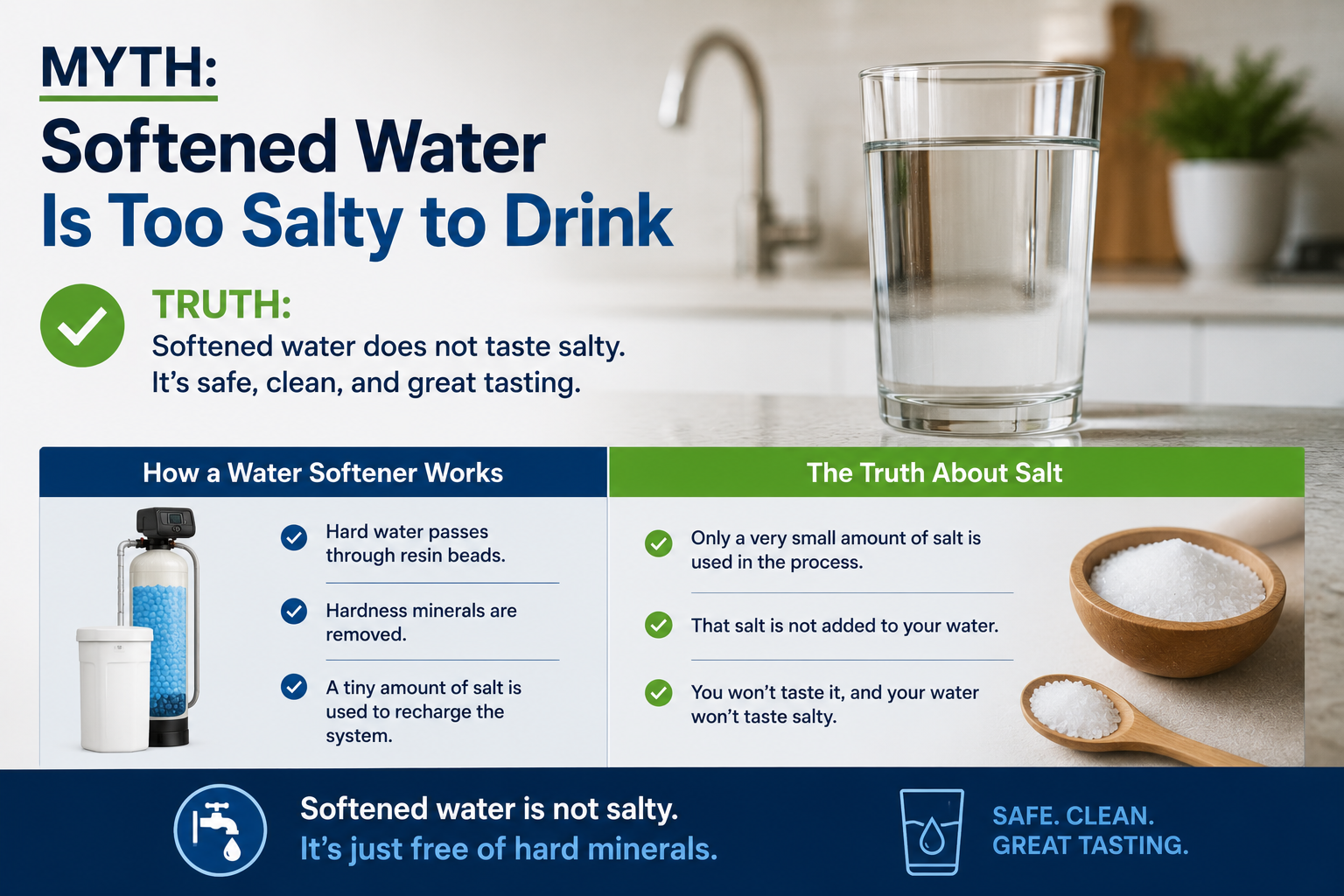
If you've ever heard that softened water tastes salty, or that the sodium added during the softening process makes it unsafe or unpleasant to drink, you're not alone. It's one of the most common concerns people raise before installing a water softener — and it's one of the easiest myths to put to rest with a little context.
Where the Myth Comes From
The concern makes intuitive sense. A water softener works by replacing calcium and magnesium ions with sodium ions through a process called ion exchange. Sodium goes into the water. Salt is sodium chloride. Therefore, softened water must taste salty, right?
The logic sounds reasonable. But it ignores the actual quantities involved — and quantity is everything when it comes to taste and health.
How Much Sodium Is Actually Added
The amount of sodium added to softened water depends entirely on how hard the original water was. The harder the water, the more calcium and magnesium get replaced, and the more sodium gets added in the exchange.
Here's what that looks like in real numbers for Florida water:
- Water at 10 grains per gallon hardness: approximately 75 mg of sodium per liter after softening
- Water at 20 grains per gallon hardness: approximately 150 mg of sodium per liter after softening
- Water at 30 grains per gallon hardness: approximately 230 mg of sodium per liter after softening
To put those numbers in context:
- A slice of white bread contains about 150 mg of sodium
- A cup of milk contains about 100 mg of sodium
- A single serving of most canned soups contains 800 mg or more of sodium
- The FDA's daily recommended limit for sodium is 2,300 mg
Even at Florida's higher hardness levels, the sodium in softened water represents a small fraction of typical daily sodium intake — and at moderate hardness levels, it's comparable to drinking a glass of milk.
Does Softened Water Taste Salty?
For the vast majority of people drinking softened water from Florida's typical hardness levels, the answer is no — softened water does not taste noticeably salty.
Human taste perception of sodium in water typically requires concentrations around 200 to 300 mg per liter before most people detect a salty taste. At the sodium levels produced by softening Florida water of average hardness, most people cannot taste the difference between softened and unsoftened water in a blind taste test.
In fact, many people find softened water tastes cleaner and smoother than the hard water they were used to — because the mineral taste of calcium and magnesium has been removed along with the hardness.
If your softened water does taste noticeably salty, that's a signal that something may be off with your softener's settings or brine rinse cycle — not a normal outcome of proper softener operation.
Who Should Actually Pay Attention to Sodium in Softened Water
While softened water is safe and tasteless for most healthy adults, there are specific groups for whom sodium in drinking water is worth a conversation with their doctor:
People on medically restricted low-sodium diets. If your physician has placed you on a strict sodium restriction due to heart disease, hypertension, or kidney disease, the added sodium in softened water may be a factor to discuss. In these cases, an under-sink reverse osmosis system at the kitchen tap removes the sodium along with virtually everything else — giving you purified drinking water without the softener's sodium contribution.
Infants drinking formula. Formula prepared with softened water delivers additional sodium to infants whose kidneys aren't fully developed. Parents preparing infant formula should use reverse osmosis water or unsoftened water rather than softened tap water.
For everyone else — the vast majority of homeowners — the sodium in properly softened water is not a meaningful health or taste concern.
The Easy Solution for Anyone Who's Still Concerned
If the sodium question makes you uncomfortable regardless of the numbers, the solution is simple: an under-sink reverse osmosis system at your kitchen sink. RO removes sodium, along with virtually every other dissolved contaminant, producing water that is as close to pure as consumer-level treatment can achieve.
Many Florida homeowners run a whole-house water softener for appliance protection, laundry, and shower benefits — and add an under-sink RO for the water they actually drink and cook with. The softener protects the house. The RO addresses any remaining concerns about drinking water specifically.
It's the best of both systems, and it makes the sodium question completely irrelevant.
The Bottom Line
Softened water is not salty. The sodium added during the softening process is, for most people, imperceptible in taste and insignificant in the context of normal daily sodium intake. The myth persists because the logic of "sodium goes in, therefore it tastes salty" sounds reasonable — but the actual amounts involved tell a very different story.
If you've been avoiding a water softener because you were worried about the taste or sodium content of the water, that concern is unlikely to be the problem you're imagining. And if it is a concern for specific health reasons, a reverse osmosis system resolves it completely.
Dependable Water Treatment installs water softeners and reverse osmosis systems for Florida homeowners. Contact us to find the right combination for your home and your household's needs.