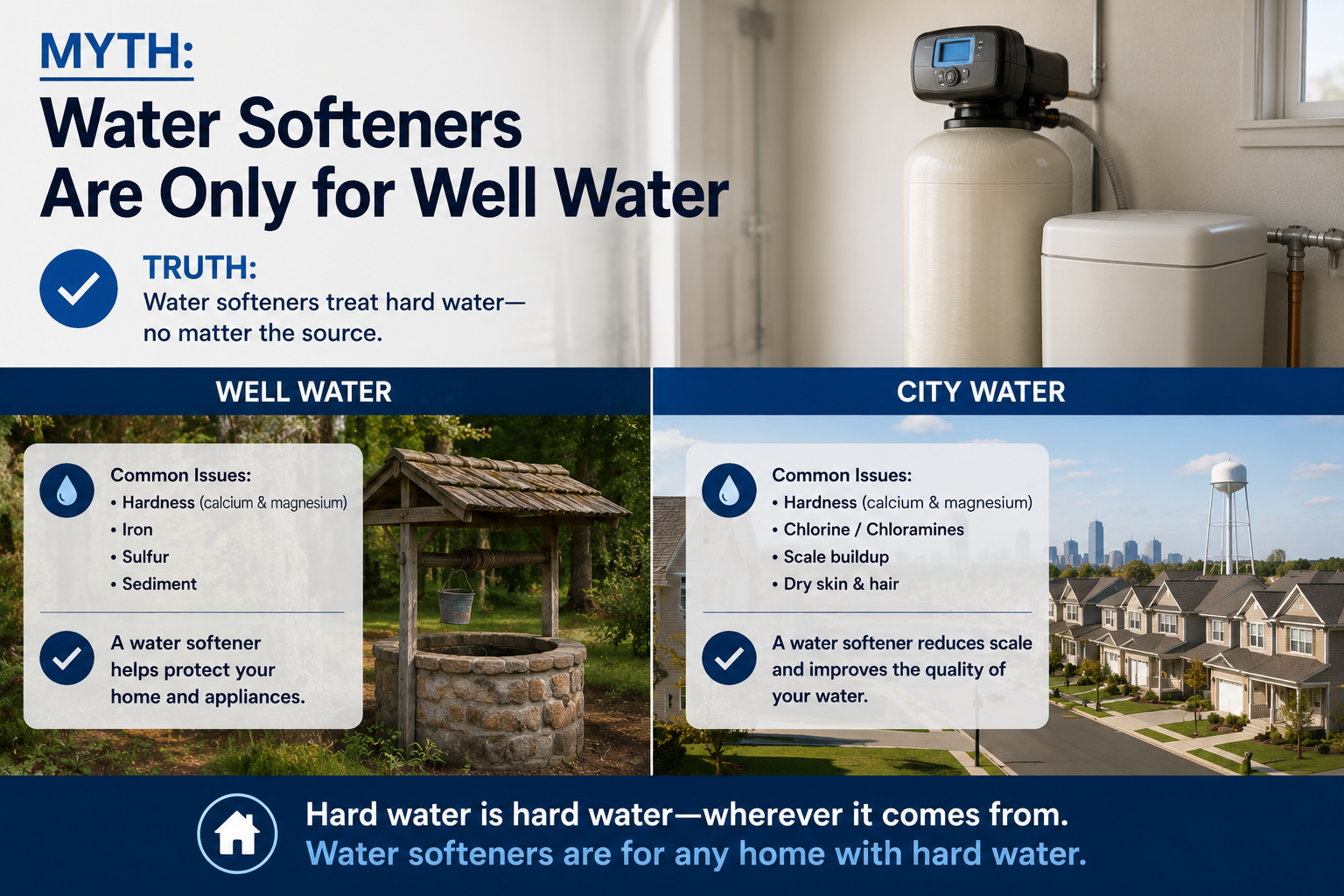
It's a common assumption: if you're on city water, your water has already been treated, so you don't need a water softener. Softeners are for well water — that rural, untreated water that comes straight out of the ground. If you're connected to municipal water, you're covered.
This myth keeps a huge number of Florida homeowners on city water living with hard water problems they assume don't apply to them. Let's clear it up.
The Myth
The reasoning goes like this: well water comes straight from the ground with no treatment, so it makes sense that it would need a softener. Municipal water, on the other hand, goes through a treatment plant before it reaches your home — surely that treatment addresses hardness too.
It's a logical-sounding assumption. It's also incorrect.
What Municipal Water Treatment Actually Does
Water treatment plants exist primarily to make water safe to drink — not to make it ideal for household use. Municipal treatment typically focuses on:
- Disinfection — killing bacteria, viruses, and other pathogens, usually with chlorine or chloramines
- Filtration — removing sediment, debris, and particulate matter
- pH adjustment — keeping water within a safe and non-corrosive range
- Removing specific regulated contaminants — based on EPA standards for things like lead, certain chemicals, and bacteria
Nowhere in that list is hardness removal. Calcium and magnesium — the minerals that make water "hard" — are not considered a safety issue, so municipal treatment plants have no requirement or incentive to remove them. The hardness in your source water goes straight through the treatment plant and into your home's pipes, completely unchanged.
Florida City Water Is Often Just as Hard as Well Water
This is the part that surprises people most. Florida's groundwater — which feeds both private wells and many municipal water systems — comes from the same aquifer system. The Floridan Aquifer and other groundwater sources that supply private wells are frequently the same sources that municipal utilities draw from to supply entire cities.
That means the water coming out of your tap on a municipal system in much of Florida can be just as hard — sometimes harder — than the well water on a property a mile away. Cities throughout Central Florida, in particular, have documented hardness levels in their municipal supply that rival or exceed many private wells in the same region.
If you're on city water and assuming you don't have a hardness problem because "the city treats it," that assumption is very likely incorrect.
How to Actually Know
The only way to know your water's hardness level is to test it — regardless of whether you're on well water or city water. A water test will tell you exactly how hard your water is in grains per gallon, and that number is what determines whether a water softener would benefit your home.
Many municipal utilities publish hardness data in their annual water quality report (Consumer Confidence Report), so you may be able to find a general figure for your area without even testing your own tap. But because hardness can vary somewhat across a distribution system, an actual test of your home's water gives you the most accurate picture.
Why This Myth Persists
Part of the reason this myth sticks around is that municipal water does solve real problems — particularly safety concerns like bacteria and certain contaminants — and people reasonably assume that "treated" means "fully addressed." It's an understandable leap, but it conflates two very different kinds of water treatment: safety treatment and aesthetic/performance treatment.
Hardness affects your daily life in ways that have nothing to do with safety: spotted dishes, dry skin, stiff laundry, scale-damaged appliances, clogged showerheads. None of those issues are addressed by the disinfection and filtration that makes municipal water safe to drink.
What This Means for Your Home
If you're on municipal water in Florida and you've noticed white buildup on faucets, spots on your dishes, dry skin after showering, or any of the other classic hard water symptoms, none of that is unusual or unexpected for city water in this state. Your water utility did its job — it delivered safe water. Hardness was never part of the assignment.
A water softener works exactly the same way and provides exactly the same benefits whether your source water comes from a private well or a municipal treatment plant. The technology doesn't care where the water came from — it responds to what's actually dissolved in it.
The Bottom Line
Being on city water tells you your water has been treated for safety. It tells you nothing about whether your water is hard. In much of Florida, municipal water and well water draw from the same hard, mineral-rich groundwater sources — and city water customers experience the exact same hardness-related problems that well water customers do.
The only way to know for sure is to test your water. If it comes back hard — and in Florida, there's a good chance it will — a water softener will solve the same problems for you that it solves for your well-water neighbors, regardless of which pipe your water travels through to get to your home.
Not sure if your municipal water is hard? Dependable Water Treatment tests water for Florida homeowners on both city water and private wells. Contact us to find out what's really in your tap.