There's a persistent and appealing idea that well water is somehow more natural, more pure, and less processed than municipal water — untouched by chemicals, straight from the earth the way nature intended. It's an understandable assumption, but it doesn't hold up against what's actually happening underground before that water reaches your tap.
The Myth
The reasoning goes like this: municipal water is chemically treated, filtered, and processed before it reaches your home, while well water comes directly from the ground with no treatment at all — so it must be cleaner, more natural, and closer to how water is supposed to be.
What's Actually Happening Underground
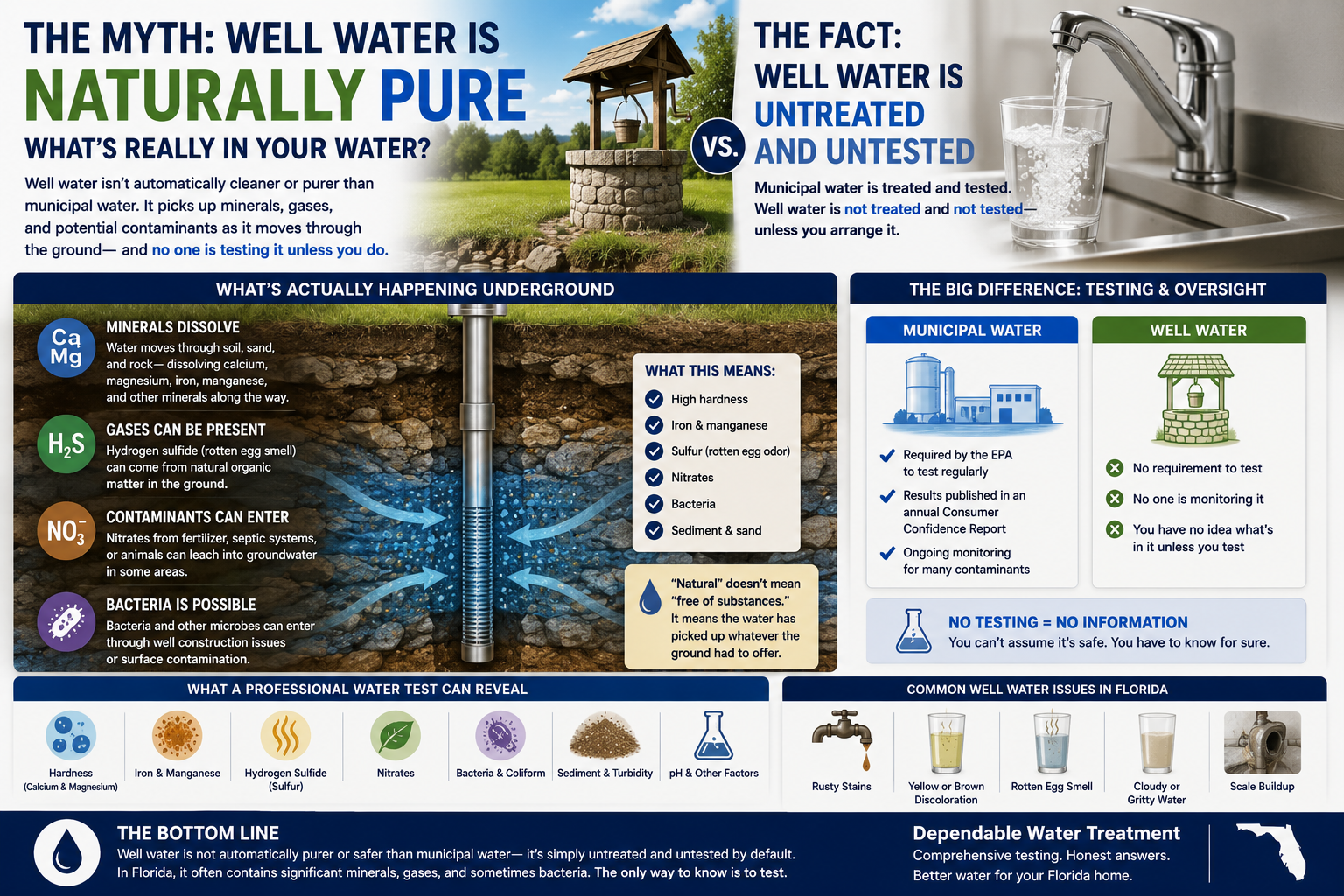
Groundwater isn't sitting in a pristine, sealed reservoir. It's moving slowly through soil, sand, and rock formations — and as covered in our article on what hard water is and how it forms, that journey through the ground is exactly what dissolves calcium, magnesium, iron, manganese, and other minerals into the water in the first place. "Natural" doesn't mean "free of substances" — it means the water has picked up whatever the ground it traveled through had to offer, and in Florida's mineral-rich geology, that's often quite a lot.
Beyond minerals, groundwater can pick up hydrogen sulfide from organic decomposition, nitrates from agricultural or septic system sources in the surrounding area, and in some cases bacteria or other contaminants depending on the well's construction, depth, and proximity to potential contamination sources. None of this is filtered out simply because the water traveled underground rather than through a treatment plant.
No Testing Happens Automatically
Perhaps the most important distinction between well water and municipal water isn't about the water itself — it's about oversight. Municipal water utilities are required by the EPA to test their water regularly and publish results in an annual Consumer Confidence Report. Private wells have no equivalent requirement. As covered in our article on what a professional water test actually measures, nobody is testing your well water unless you do it yourself. Assuming it's pure because it's untested is exactly backward — the absence of testing means the absence of information, not the absence of problems.
The Bottom Line
Well water isn't inherently purer than municipal water — it's simply untreated and untested by default, carrying whatever minerals, gases, and potential contaminants the surrounding geology and land use have introduced along the way. In Florida, that often includes significant hardness, iron, and sometimes sulfur or bacteria. The only way to know what's actually in your well water is to test it — "natural" is not a water quality standard.
Dependable Water Treatment offers comprehensive well water testing for Florida homeowners. Contact us to find out what's really in your water.