
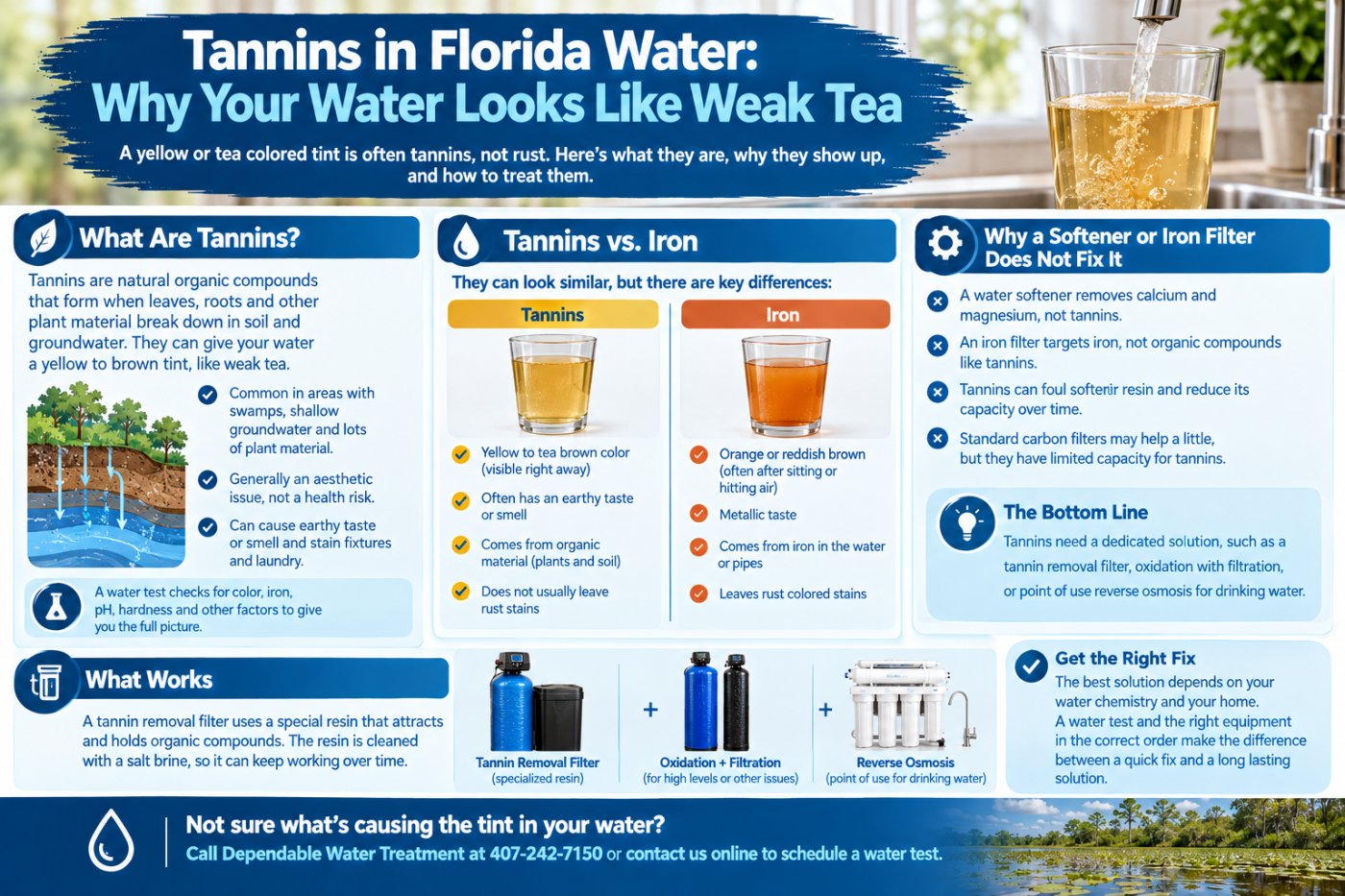
If your water has a pale yellow or tea colored tint, especially in a full bathtub or a clear glass held up to the light, there is a good chance you are looking at tannins. Tannins are one of the more confusing water problems in Central Florida, because they look a lot like rust, they often show up alongside iron, and the equipment that handles hardness or iron does very little about them. Understanding what tannins are and why they resist ordinary treatment is the first step to getting rid of the color.
What Tannins Are and Where They Come From
Tannins are organic compounds that form when vegetation such as leaves, roots, and peat breaks down in soil and groundwater. Florida has plenty of both. Swampy ground, shallow groundwater, and areas with a lot of decaying plant material all produce water that picks up these compounds on its way into a well or the supply. The result is the same tint you see when you steep a tea bag, and it can range from a faint yellow to a deep brown depending on how much organic material the water has absorbed.
Tannins are generally considered an aesthetic issue rather than a health one. They do not usually make water unsafe, but they can give it an earthy or bitter taste, stain fixtures and laundry, and make the water unpleasant to drink. They are also often a sign that other things are going on, such as low pH or organic matter that can feed bacteria. That is why we always recommend a full water test, as described in our article on what a professional water test measures.
How to Tell Tannins From Iron
Because both can tint water, homeowners often assume iron. There are a few clues that point toward tannins. Iron water tends to leave orange or reddish brown stains that appear after the water sits or hits air, while tannin water is tinted the moment it leaves the tap, and the color is more yellow or tea brown. Tannin water often has a faint earthy taste or smell. The color may also be stronger after heavy rain, when more organic material is washed into the ground.
It is possible to have both at once, and when iron is bound to organic material it becomes harder to remove than ordinary iron. A test that measures color along with iron, pH, and hardness gives a much clearer picture than guessing from appearance. Our article on black specks and flakes in well water covers some of the other things that can show up in the same kinds of water.
Why a Softener or Iron Filter Does Not Fix It
A water softener is designed to remove calcium and magnesium, and an iron filter is designed to oxidize and trap iron. Neither is built to remove large organic molecules like tannins. Even worse, tannins can foul softener resin. The organic material attaches to the resin beads and gradually reduces their capacity, which is one reason a home with tannins can see a softener underperform over time. If you have noticed your softener losing effectiveness, the water may be carrying more than hardness.
Standard carbon filters can reduce some organic compounds, but their capacity for tannins is limited and they can be exhausted faster than expected when color is heavy.
What Does Work
The most common solution is a tannin removal filter, which uses a specialized resin designed to attract and hold organic compounds. The resin is cleaned periodically with a salt brine, much like a softener regenerates, so it can keep working over time. These systems work best when the water chemistry cooperates, and factors such as pH and the presence of iron affect how well they perform, so they are typically set up as part of a larger plan rather than a stand alone fix.
Other approaches include oxidation with a chemical feed followed by filtration, and point of use reverse osmosis for drinking water, which we explain in our article on how reverse osmosis purifies your water. Which approach fits depends on how much color is present and what else is in the water.
Getting the Right Fix for Your Home
Tannin treatment tends to go wrong when it is guessed at. Putting in the wrong equipment can leave the color in place and wear out the equipment you already have. Matching the system to your water test, and placing each stage in the correct order, is what makes the difference. Our article on how to determine what water treatment your home needs explains how that decision gets made.
Is your water tinted yellow or brown? We can test it and tell you exactly what is causing it. Call Dependable Water Treatment at 407-242-7150 or contact us online to schedule a water test.