
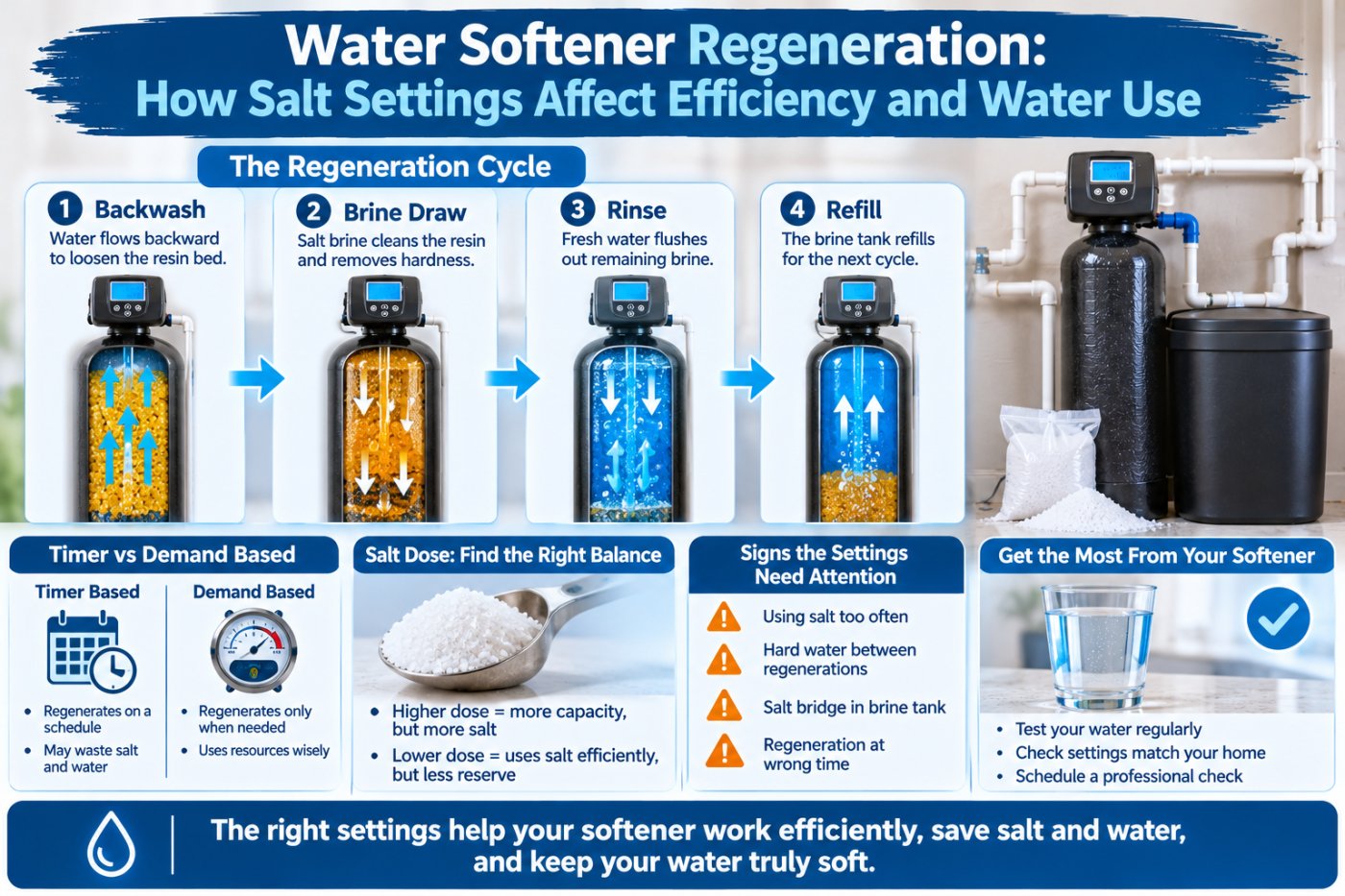
Most homeowners never think about what their water softener does overnight, and that is fine when everything is working. But the regeneration cycle is where a softener spends nearly all of its salt and a good amount of water, and the settings that control it can make the difference between a system that runs efficiently for years and one that wastes resources every week. Understanding what happens during regeneration, and which settings matter, helps you spot a softener that is overdue for an adjustment.
What Happens During a Regeneration Cycle
Over time the resin beads in your softener become loaded with the calcium and magnesium they have pulled out of your water. To restore them, the softener runs a cleaning cycle. First, water flows backward through the tank to loosen and rinse the resin bed. Next, a strong salt brine is drawn from the brine tank and passed slowly through the resin, which forces the hardness minerals off the beads and replaces them with fresh sodium. Then the tank is rinsed with fresh water to flush out the leftover brine and hardness, and finally the brine tank refills so it is ready for the next cycle.
The whole process usually runs in the middle of the night and takes a couple of hours. During it, the softener sends dozens of gallons of water to the drain, which is a normal part of how ion exchange works. We explain the underlying chemistry in our article on how long water treatment systems last, and the same principles apply here.
Timer Versus Demand Based Regeneration
How the softener decides when to regenerate matters more than most people realize. Older or simpler systems run on a timer, which means they regenerate on a fixed schedule, such as every third night, whether or not the resin needs it. If your household uses less water than usual, such as during a vacation, the softener still regenerates and wastes salt and water. If you use more than usual, the resin can run out before the timer kicks in and hard water slips into the house.
Demand based systems use a meter to track how much water has actually passed through the tank, and they only regenerate when the resin is close to exhausted. This is generally the more efficient approach, because the softener adapts to how your household really uses water. Many also keep a reserve, so a small amount of capacity is held back to cover unexpected demand between cycles.
How Salt Dosing Changes the Result
Salt dose is the amount of salt used per regeneration, and it creates a tradeoff that surprises a lot of people. A higher dose pushes more hardness off the resin and gives the tank more capacity for the next cycle, but each additional pound of salt buys less and less extra capacity. A lower dose uses salt more efficiently, meaning more hardness removed per pound, but gives you a smaller reserve of soft water between cycles.
That is why a softener with a high salt setting is not necessarily doing a better job. It may simply be spending more salt to get a small improvement. A properly set system balances these factors based on your water, your household, and the size of the tank. When a softener is correctly sized, which we cover in our article on how to determine what water treatment your home needs, it can regenerate with a moderate dose and run efficiently.
Signs the Settings Need Attention
A few clues suggest a softener is regenerating too often, too rarely, or with the wrong amount of salt. If you are adding salt much more often than you used to, the system may be regenerating more frequently than necessary, or the dose may be set too high. If hardness shows up at the tap between regenerations, the system may be running out of capacity, or the settings may not match your current water. A softener that regenerates after a power outage at the wrong time, or that has lost its programming, can also be out of sync with your household.
The brine tank deserves a glance too. A hard crust of salt, sometimes called a salt bridge, can form and leave the tank with no brine to draw even though it looks full. Our article on why some Florida homes need more than a softener covers other situations where a softener is asked to do more than it was designed for.
Getting the Most From Your Softener
The simplest way to keep a softener efficient is to verify that it is delivering soft water and that its settings still match your household. Hardness and iron levels can shift, families grow, and settings can drift after power interruptions. A hardness test at the tap tells you quickly whether the system is keeping up, and a professional check can confirm that the dose, cycle timing, and reserve are set for your home. Our article on what a professional water test measures explains what a thorough test includes.
If your softener seems to be using too much salt or letting hard water through, we can check the settings and tell you why. Call Dependable Water Treatment at 407-242-7150 or contact us online to schedule a water test.