When a home needs more than one piece of water treatment equipment, the order those pieces are installed in is not a detail. It decides whether each stage can do its job, whether the equipment lasts, and whether the water that reaches your faucets is actually clean. Two homes can own the exact same set of equipment and get very different results simply because one was plumbed in the right sequence and the other was not. Understanding the logic behind the order helps you make sense of a recommendation and spot a system that is working harder than it should.
The Basic Principle: Each Stage Protects the Next
A treatment train works like an assembly line. Each stage is built to handle a specific problem, and each one performs best when the stages ahead of it have already removed whatever would interfere with it. Sediment can clog fine filters and coat other media. Iron can foul softener resin. Chlorine and chloramines can wear down resin over the years. Cloudy or mineral heavy water can block the light a UV system relies on. If the equipment is arranged so that the toughest, most damaging contaminants are dealt with first, everything downstream lasts longer and works better.
This is also why the right order depends on your water. A home on a private well with iron and sulfur needs a different arrangement than a home on city water with chloramines and moderate hardness. A water test is what tells you which problems are present, which is why we always start there, as described in our article on what a professional water test measures.
A Typical Sequence and the Reasons Behind It
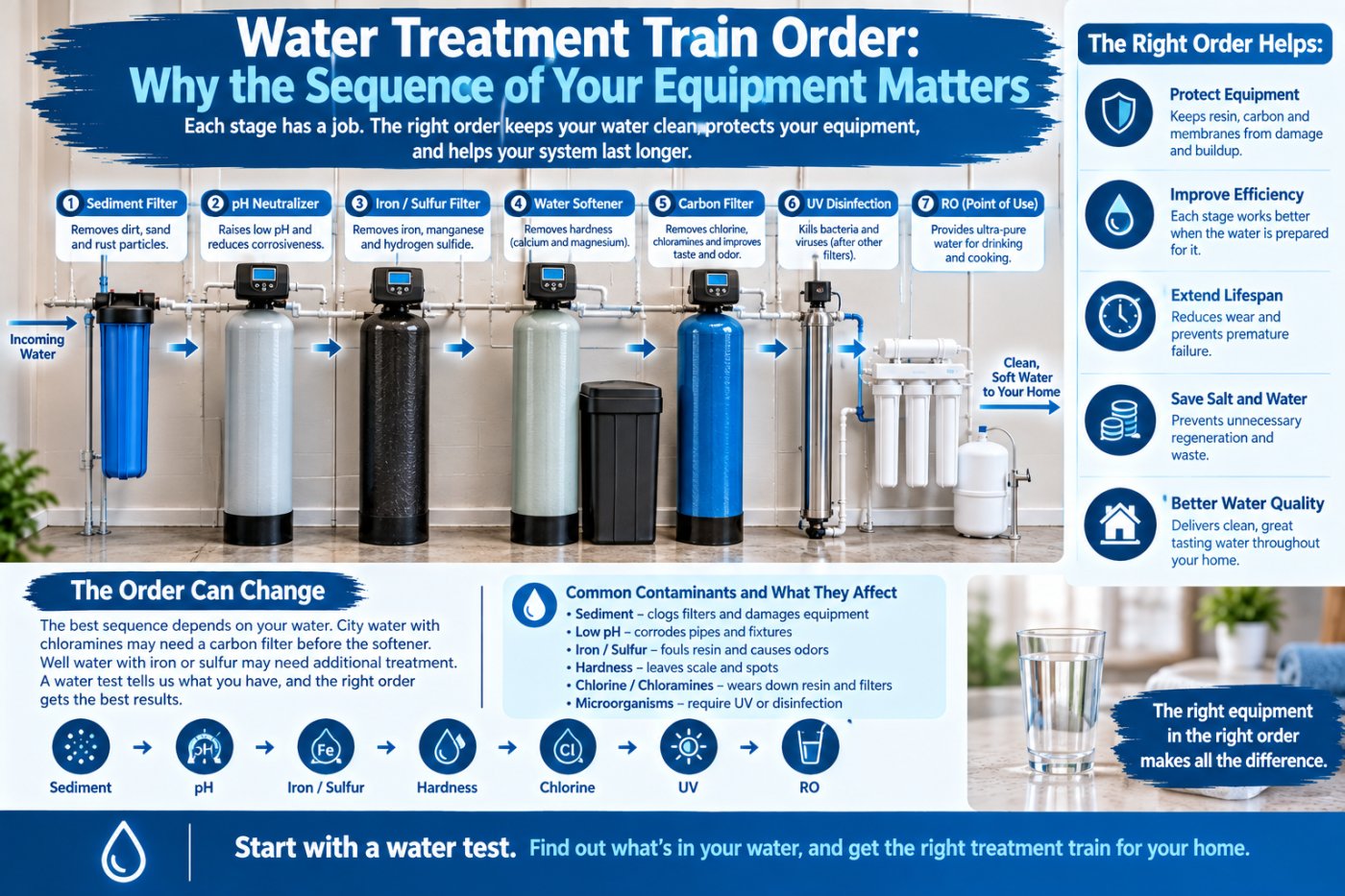
For a Florida home that needs several stages, a common arrangement looks like this, with the reasons for each position.
Sediment filtration comes first. Sand, silt, rust particles, and other debris can clog fine media and damage valves. A sediment filter at the front protects everything behind it and gives the other stages cleaner water to work with.
pH correction usually comes next if the water is acidic. Low pH water is corrosive to plumbing, and it can also interfere with how well later stages perform. Neutralizing it early protects the pipes and equipment downstream. A neutralizer can add some hardness to the water as it works, which is one reason it is placed ahead of the softener rather than after it.
Iron and sulfur treatment comes before the softener. Iron coats and fouls softener resin over time, as we explain in our article on why a softener stops softening. Removing iron and the rotten egg smell of hydrogen sulfide before the water reaches the softener keeps the resin focused on hardness. Air injection and oxidizing filters are common ways to do this, and the right choice depends on how much iron and sulfur are present.
The water softener removes hardness. With the heavy lifting of sediment, acidity, and iron out of the way, the softener can remove calcium and magnesium efficiently, which protects your pipes, water heater, and appliances.
Carbon filtration handles chlorine, chloramines, and taste. On well water with sulfur, carbon often sits after the softener to polish the water. On city water, the picture changes, which we cover below.
UV disinfection goes near the end. UV works by exposing water to ultraviolet light, so the water needs to be clear and relatively free of iron and hardness. Particles can shield microorganisms from the light, and mineral scale can cloud the lamp sleeve. Putting UV after the other stages gives it the best possible conditions.
Reverse osmosis is typically a point of use system for drinking water. It is installed at a single tap, fed by water that has already been treated, which protects the membrane and extends its life. We explain what it does in our article on how reverse osmosis purifies your water.
When the Order Changes
The sequence above is a starting point, not a rule. On city water, chlorine or chloramines are often the main concern for softener resin, so it can make sense to place a carbon filter ahead of the softener to protect it. Our article on why some Florida homes need both a softener and a carbon filter explains why, and how the type of carbon matters when chloramines are involved. Homes with unusual water, such as high tannins or very low pH, may need stages added, removed, or reordered.
This is also why a package of equipment chosen without a test can underperform. Equipment that is sound on its own can still struggle if it is placed in the wrong spot in the line, or if a stage that was never needed takes up space while a needed one is missing. We walk through how to figure out what a home actually needs in our article on how to determine what water treatment your home needs.
What to Take Away
If you are adding equipment to a system you already have, or you have a system that never seemed to work as well as it should, the order is worth checking. A softener struggling with iron, a UV system that keeps losing effectiveness, or a carbon filter that wears out quickly are all common signs that something upstream is not doing its job. A short review of your water test and your plumbing layout can usually identify the cause.
Not sure whether your equipment is set up in the right order? We can test your water and check how your system is plumbed. Call Dependable Water Treatment at 407-242-7150 or contact us online to schedule a water test.