
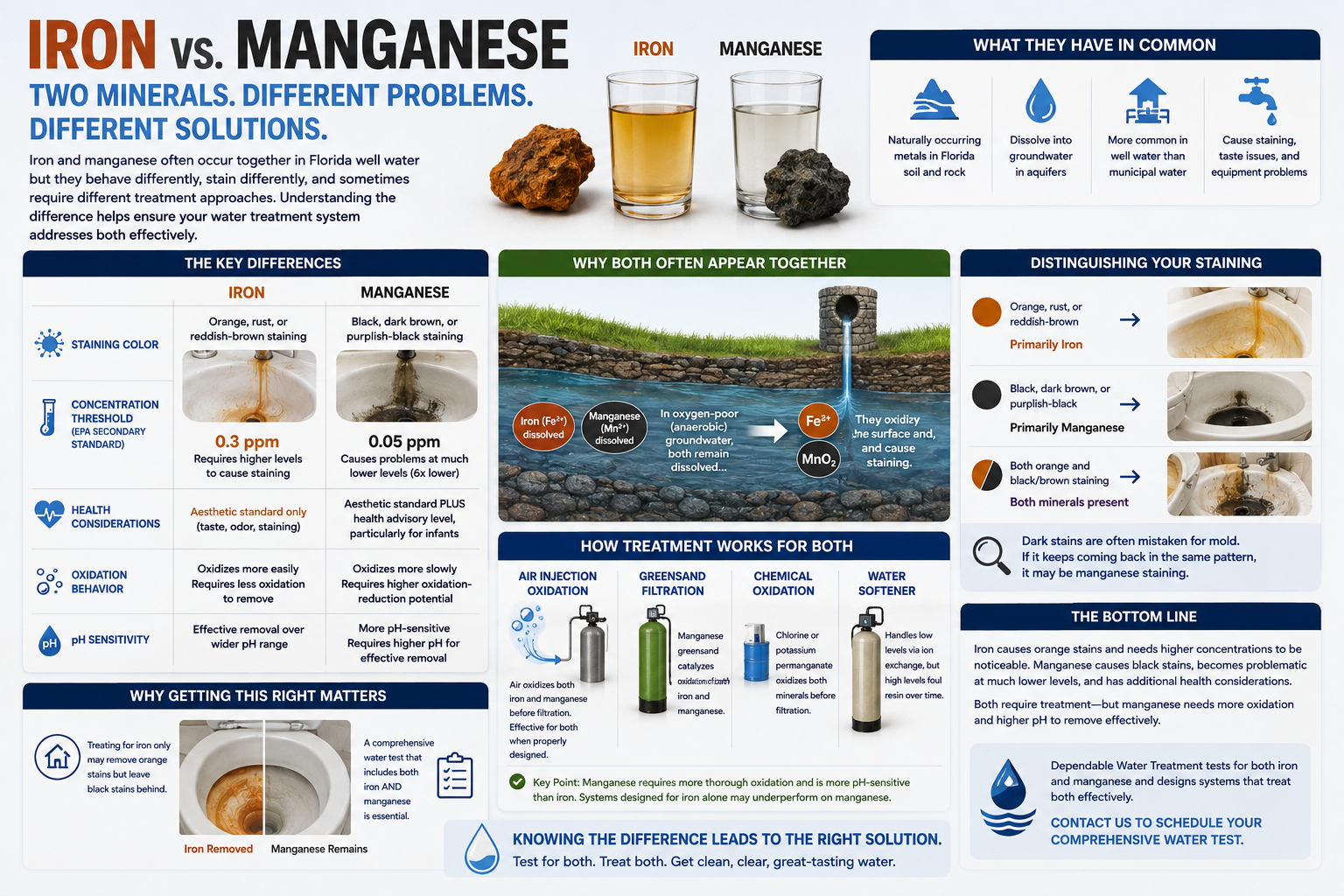
If your well water test results came back showing both iron and manganese, you might assume they're essentially the same problem with two different names. They're not. While these two minerals often travel together in Florida groundwater and cause visually similar problems, they behave differently in water, stain differently, and sometimes require different treatment approaches. Understanding the distinction helps you make sense of your water test results and ensures your treatment system actually addresses both.
What Iron and Manganese Have in Common
Iron and manganese are both naturally occurring metals found in Florida's soil and rock formations. Both dissolve into groundwater as it passes through mineral-rich geology on its way to the aquifer. Both are more common in well water than in municipal water, since municipal treatment typically removes them before water reaches your tap. And both cause staining, taste issues, and equipment problems when present in Florida well water at elevated levels.
Because they frequently occur together — a well with elevated iron often has some manganese as well — and because their effects can look similar at first glance, they're often mentally grouped together as "the same problem." But the differences matter for both diagnosis and treatment.
The Key Differences
Staining color. This is the most immediately noticeable difference. Iron produces orange, rust-colored, or reddish-brown staining — the classic discoloration you see in toilets, sinks, and tubs in homes with iron-affected well water. Manganese produces black, dark brown, or purplish-black staining — a distinctly different color that can be mistaken for mold or dirt rather than a mineral deposit. If you're seeing black or dark staining rather than orange, manganese is likely a significant contributor, possibly more than iron.
Concentration thresholds. Manganese causes noticeable staining and taste problems at much lower concentrations than iron. The EPA's secondary standard for iron is 0.3 parts per million, while the secondary standard for manganese is just 0.05 parts per million — six times lower. This means a well with what seems like a modest manganese reading can still cause significant staining, while iron typically needs to be present in more noticeable amounts before staining becomes a problem.
Health considerations. While Florida's secondary standards for both iron and manganese are primarily aesthetic (taste, odor, staining) rather than health-based, manganese has additional health considerations that iron does not. The EPA has established a health advisory level for manganese in drinking water, particularly relevant for infants, due to research suggesting that elevated manganese exposure may affect neurological development in young children. This makes manganese testing and treatment somewhat more health-relevant than iron treatment, which is driven primarily by aesthetic concerns.
Oxidation behavior. Both minerals oxidize when exposed to air or chlorine, converting from a dissolved, invisible form to a solid, visible form that can be filtered out. However, manganese oxidizes more slowly and requires a higher oxidation-reduction potential than iron — meaning treatment systems designed only for iron removal sometimes underperform on manganese unless specifically configured to address both. This is one of the most common reasons a well water treatment system removes iron effectively but leaves manganese staining unresolved.
pH sensitivity. Manganese removal is generally more pH-sensitive than iron removal, often requiring a higher pH range for effective oxidation and filtration. As covered in our article on why water pH matters for your home, water treatment systems designed to address both iron and manganese often need to account for this difference in pH sensitivity to perform effectively on both minerals simultaneously.
Why Both Often Appear Together in Florida Wells
Iron and manganese frequently occur together in groundwater because they form under similar geochemical conditions — typically in oxygen-poor (anaerobic) groundwater environments where both minerals remain in a dissolved, reduced state until they reach the surface and encounter oxygen. Florida's aquifer systems, with their extensive limestone and organic-rich formations, provide conditions where both minerals commonly dissolve into groundwater together.
This means a comprehensive well water test that includes both iron and manganese — rather than just iron alone — is important for understanding your full water chemistry. A test that only reports iron might miss a manganese problem that's contributing significantly to staining, particularly the darker or black staining that iron alone doesn't fully explain.
Distinguishing Your Staining: A Practical Guide
If you're trying to get a sense of which mineral is primarily responsible for staining in your home before getting formal test results, the color is your best clue:
- Orange, rust, or reddish-brown staining — primarily iron
- Black, dark brown, or purplish-black staining — primarily manganese
- A combination of orange and black/brown staining in different areas — both minerals present, potentially at different relative concentrations in different parts of your plumbing
Manganese staining is sometimes mistaken for mold growth because of its dark color and tendency to appear in similarly damp locations — toilet tanks, humidifier reservoirs, and areas of standing water. If you've been scrubbing what you thought was mold and it keeps coming back in the same pattern, it may actually be manganese staining rather than biological growth.
How Treatment Differs
Both iron and manganese are typically addressed through oxidation followed by filtration — but the specifics matter for effective treatment of both simultaneously.
Air injection oxidation systems are effective for both iron and manganese when properly designed, using air to oxidize both minerals before filtering them out. These systems are popular for Florida well water precisely because they can be configured to address both minerals in a single treatment stage.
Greensand filtration uses manganese greensand media — itself containing manganese oxide — to catalyze the oxidation of both iron and manganese, making it effective for combined iron/manganese removal. This is one of the more traditional and well-established approaches for treating both minerals together.
Chemical oxidation (chlorine or potassium permanganate injection) followed by filtration is effective for higher concentrations of either mineral, and can be calibrated to ensure adequate oxidation of both, since manganese requires more aggressive oxidation than iron to convert fully to a filterable form.
Water softeners can handle low levels of dissolved iron and manganese through ion exchange, similar to how they handle calcium and magnesium, but as covered in our article on what iron in water does to your home, this approach has limits — higher concentrations of either mineral foul the resin bed over time and are better addressed with dedicated iron/manganese treatment ahead of the softener.
The key point for any treatment system addressing both minerals: because manganese requires more thorough oxidation and is more pH-sensitive than iron, a system designed and calibrated only with iron in mind may underperform specifically on manganese, even while successfully addressing iron. Confirming that your treatment system has been specifically evaluated for manganese removal — not just iron removal — matters when both are present in your well water test results.
Why Getting This Right Matters
A homeowner who addresses their iron problem but overlooks manganese may see their orange staining disappear while dark staining persists — a confusing and frustrating outcome that can make it seem like the treatment system isn't working, when in reality it's working correctly for iron but wasn't configured to address manganese at all.
This is one of the clearest examples of why a comprehensive water test — one that specifically measures manganese alongside iron rather than treating them as a single combined reading — is essential for designing a treatment system that actually solves the full problem.
The Bottom Line
Iron and manganese are related but distinct minerals that frequently occur together in Florida well water. Iron causes orange staining and requires elevated concentrations to become noticeable; manganese causes black staining and becomes problematic at much lower concentrations, with additional health considerations particularly relevant for households with infants. Effective treatment requires addressing both — with attention to manganese's greater oxidation and pH requirements — rather than assuming a system designed for iron alone will handle manganese equally well.
If you're dealing with staining that includes dark or black discoloration alongside orange, or if your water test shows manganese present, make sure your treatment system has been specifically designed to address it.
Dependable Water Treatment tests Florida well water for both iron and manganese and designs treatment systems that address both effectively. Contact us to schedule a comprehensive water test.