If you've noticed your shower pressure getting weaker over time, water spraying in odd directions, or some of the spray holes completely blocked — you're dealing with one of the most common and frustrating hard water problems in Florida homes. Showerhead clogging is so common here that many people just accept it as normal. It's not. It's a symptom of a water quality problem that affects your entire home, and it's completely preventable.
What's Actually Clogging Your Showerhead
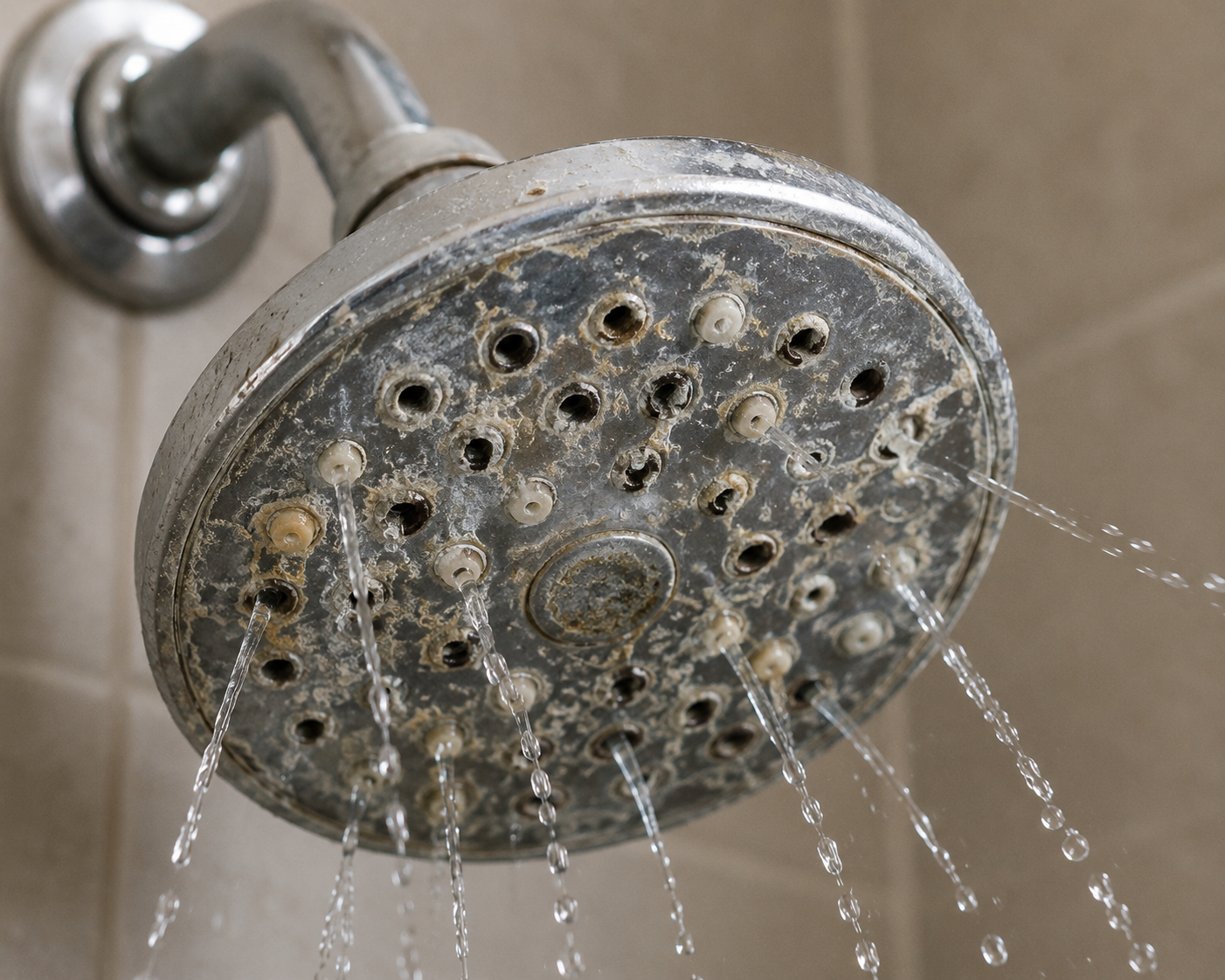
The white, chalky buildup clogging the spray holes in your showerhead is mineral scale — the same calcium and magnesium deposits that build up on your faucets, inside your water heater, and throughout your plumbing. Every time hard water passes through your showerhead, it leaves a tiny mineral deposit behind. Over time those deposits accumulate until they partially or completely block the small spray holes.
Florida water is particularly aggressive at causing this buildup because of how hard it is. Many areas of Central and South Florida have water hardness levels of 15 to 25+ grains per gallon — some of the highest in the country. At those levels, visible mineral buildup on a showerhead can appear within weeks of installation on a new fixture.
Why the Spray Pattern Changes
When scale builds up unevenly across the spray holes — which it almost always does — some holes get more restricted than others. The result is a showerhead that sprays in inconsistent directions, with some streams going sideways, some barely trickling, and others shooting at an unexpected angle.
That uneven spray pattern is a sign that scale buildup has progressed beyond the early stages. At this point, soaking or cleaning can help, but the buildup inside the showerhead body — not just on the surface of the spray holes — may be significant enough that no amount of cleaning fully restores the original performance.
The Rubber Nozzle Problem
Many modern showerheads have rubber spray nozzles — the small flexible tips on each spray hole — specifically designed to make cleaning easier. The idea is that you can rub your finger across the nozzles and the flexible rubber breaks up surface mineral deposits.
This works to a degree for light buildup. But when Florida hard water is involved, the scale accumulation goes beyond what a finger rub can address. Scale builds up around and behind the rubber nozzles, inside the showerhead body, and in the filter screen at the connection point — none of which is addressed by rubbing the surface nozzles.
The Filter Screen Inside Your Showerhead
Most people don't know their showerhead has a small filter screen at the inlet — the connection point where it screws onto the pipe. This screen is designed to catch debris coming through the water line. In a hard water home, it also catches mineral particles and becomes clogged with scale over time.
A clogged inlet screen significantly reduces water flow to the showerhead — which means weak pressure even if the spray holes themselves are relatively clear. If you unscrew your showerhead and look at the connection end, you'll often find a small screen that's partially or completely packed with mineral deposits and debris.
Cleaning or replacing that screen alone can sometimes produce a noticeable improvement in pressure — but it's a temporary fix if the underlying water quality isn't addressed.
How Often Are Florida Homeowners Replacing Showerheads?
In homes with untreated hard water, showerhead replacement becomes a recurring expense. A showerhead that should last 5 to 10 years or more with normal use may need replacing every 1 to 3 years in a Florida home where scale buildup is severe and cleaning only provides temporary relief.
Multiply that across multiple bathrooms, factor in the time spent cleaning and replacing fixtures, and the ongoing cost of hard water's effect on your showerheads becomes a real household expense — one that most people absorb without realizing it's preventable.
Cleaning Methods — What Works and What Doesn't
White vinegar soak. The most commonly recommended DIY fix. Removing the showerhead and soaking it in undiluted white vinegar for several hours — or overnight for heavy buildup — dissolves calcium and magnesium deposits effectively. For showerheads you don't want to remove, filling a plastic bag with vinegar and securing it around the showerhead with a rubber band achieves a similar result.
Vinegar works well for moderate buildup and restores reasonable performance in many cases. The limitation is that it only addresses what's on the showerhead itself — not the scale inside your pipes, inside your water heater, or anywhere else in your plumbing system.
Commercial descalers. Products specifically designed to dissolve mineral scale are available and can be more effective than vinegar for heavy buildup. They work on the same acid principle — dissolving the calcium carbonate that makes up scale deposits.
Replacement. When buildup is severe enough that cleaning doesn't restore acceptable performance, replacement is the practical solution. But in a hard water home without water treatment, you're just starting the cycle over again.
What doesn't work. Bleach does nothing for mineral scale. Abrasive scrubbing can damage finish and rubber components. And no amount of cleaning addresses the source of the problem.
What Hard Water Does Beyond the Showerhead
While your showerhead is the most visible casualty of hard water in your bathroom, it's worth understanding that the same process is happening everywhere water flows in your home.
Your faucet aerators — the small screens at the tip of every faucet — accumulate the same mineral buildup and restrict flow in the same way. Your shower valve internals develop scale that affects mixing and temperature control. The pipes in your walls narrow over time as scale builds up on the interior surface. Your water heater, dishwasher, and washing machine are all accumulating scale with every use.
The showerhead is just the most visible indicator of a whole-home water quality problem.
The Permanent Fix
Cleaning your showerhead addresses the symptom. Treating your water addresses the cause.
A whole-house water softener removes calcium and magnesium from your water before it reaches any fixture in your home. With softened water flowing through your showerhead:
- Scale cannot form on the spray nozzles, inside the showerhead body, or on the inlet screen
- Spray patterns stay consistent because all holes remain unobstructed
- Water pressure stays strong because there's nothing restricting flow
- Your showerhead lasts as long as it's designed to — years or decades rather than months
- Every other fixture and appliance in your home gets the same protection
Many homeowners notice the difference in their shower experience almost immediately after a water softener is installed — better pressure, more consistent spray, and water that feels noticeably different on their skin.
A Note on Showerhead Filters
Showerhead filters are a popular product for people who want to improve their shower water without a whole-house system. They attach between the pipe and the showerhead and typically contain KDF media, vitamin C, or activated carbon to reduce chlorine and some other contaminants.
They can help with chlorine and chloramine reduction, which is beneficial for skin and hair. However, most showerhead filters are not effective at removing the hardness minerals that cause scale buildup. They may slow the rate of buildup slightly, but they won't prevent it — and they require frequent cartridge replacement to maintain any effectiveness.
A showerhead filter is not a substitute for a water softener when hard water is the core problem.
The Bottom Line
Your showerhead isn't clogging because it's a bad showerhead or because you're not cleaning it often enough. It's clogging because Florida's hard water is depositing minerals on every surface it touches — and your showerhead's small spray holes are just the most obvious place where that buildup becomes a problem you can see and feel immediately.
The cleaning routine will never end as long as the water causing the buildup isn't being treated. A water softener ends the cycle permanently — protecting your showerhead, your fixtures, your appliances, and your plumbing all at once.
If you're tired of dealing with weak pressure, erratic spray patterns, and constant showerhead replacements, your water is the place to start.
Dependable Water Treatment helps Florida homeowners stop hard water buildup at the source with whole-house water softeners and treatment systems. Contact us to schedule a water test and find out what your water is doing to your home.