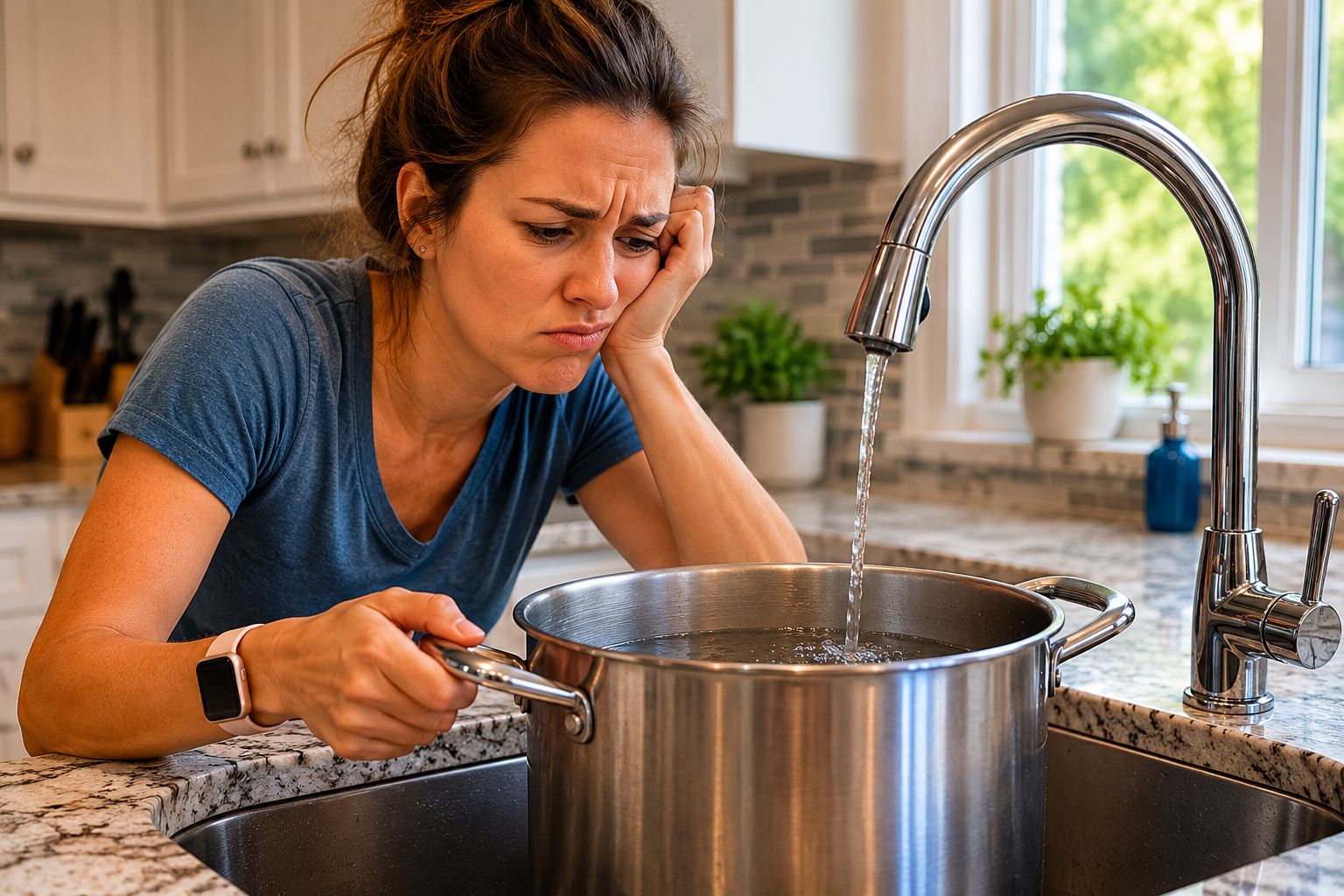
There's nothing quite as frustrating as a shower that used to feel great and now barely trickles. Or a kitchen faucet that used to fill a pot in seconds and now takes twice as long. If your water pressure has been gradually declining and you can't figure out why, there's a good chance the answer is hiding inside your pipes and fixtures — and in Florida, hard water and mineral buildup are the most common culprits.
Water Pressure Doesn't Usually Drop Overnight
One of the things that makes gradual pressure loss so easy to miss is that it happens slowly. You don't wake up one day to suddenly terrible pressure — it fades over months or years, so gradually that you almost don't notice until it's significantly worse than it used to be.
That slow progression is actually a clue. Sudden pressure loss usually points to a specific event — a pipe break, a municipal supply issue, a failing pressure regulator. But gradual pressure loss that develops over time almost always points to accumulation — something building up inside your plumbing that's slowly restricting water flow.
In Florida, that something is almost always mineral scale from hard water.
How Hard Water Builds Up Inside Your Pipes
Every time hard water flows through your pipes, it leaves a tiny deposit of calcium and magnesium behind. Each individual deposit is microscopic — completely invisible. But over months and years, those deposits accumulate layer by layer on the inside walls of your pipes, gradually narrowing the opening that water has to flow through.
Think of it like cholesterol buildup in arteries. The pipe doesn't close off suddenly — it narrows slowly, and the effect on flow becomes more noticeable as the buildup progresses.
This process is called scaling, and it happens in every pipe in your home that carries hard water — supply lines, hot water lines, the pipes inside your walls, and the connections to every fixture and appliance. Older homes that have had hard water running through them for decades can have significant scale buildup throughout the entire plumbing system.
Hot water pipes are affected faster and more severely than cold water pipes, because heat accelerates mineral precipitation. If your hot water pressure is noticeably worse than your cold water pressure, scale buildup is a very likely explanation.
Your Fixtures and Showerheads Are Affected Too
It's not just your pipes. The small openings in your showerheads, faucet aerators, and fixture valves are prime locations for mineral buildup — and because those openings are already small, it doesn't take much buildup to noticeably restrict flow.
If you unscrew your showerhead and look inside, you may find significant white or yellowish mineral deposits clogging the small spray holes. The same thing happens in the aerator screen on your kitchen and bathroom faucets. These can be cleaned or replaced, and doing so often produces an immediate improvement in pressure at that specific fixture.
But if the pressure problem is throughout your whole house — not just at one fixture — the issue goes deeper than a clogged showerhead.
The Water Heater Connection
Your water heater is another major location where scale accumulates and affects performance. As scale builds up on the heating element and inside the tank, it doesn't just reduce efficiency and increase energy costs — it also affects water flow.
Scale buildup in the inlet and outlet connections of your water heater can restrict flow significantly over time. If your hot water pressure is consistently lower than your cold water pressure throughout the house, your water heater's scale buildup is a likely contributing factor.
In severe cases, scale accumulation inside tankless water heaters can partially or fully block the narrow internal passages, causing dramatic pressure drops specifically in hot water lines.
Well Water Pressure: Additional Factors
If your home is on well water, there are additional factors that can contribute to pressure loss — some related to water quality, some related to the well system itself.
Iron buildup. Iron in well water causes buildup inside pipes just like calcium and magnesium do — but the deposits are rust-colored rather than white. Iron buildup can be even more aggressive than calcium scale in some cases, and it affects not just pressure but also the condition of your pipes over time.
Pressure tank issues. Your well system includes a pressure tank that maintains consistent water pressure between pump cycles. If the pressure tank's bladder fails or becomes waterlogged, pressure throughout the house becomes erratic — strong initially after the pump runs, then dropping off quickly. This is a mechanical issue rather than a water quality issue, but it's a common cause of pressure complaints in Florida well water homes.
Well pump wear. Over time, well pumps wear out. A pump that's losing efficiency delivers less pressure than it used to. If your pressure issues are accompanied by the pump running more frequently or longer than it used to, pump condition is worth evaluating.
Clogged well screen. The screen at the bottom of your well that prevents sediment from entering can become partially clogged with mineral deposits, iron, or sand over time, reducing the flow of water into the well and affecting system pressure.
Municipal Water Pressure Issues
If you're on city water rather than a well, pressure loss can also come from:
Your pressure regulator. Most homes connected to municipal water have a pressure regulating valve (PRV) where the water line enters the home. These valves are designed to last many years, but they do fail over time. A failing PRV can cause pressure to drop gradually or fluctuate unpredictably. Replacing it is a relatively straightforward plumbing repair.
Main line scale buildup. Even on city water, scale builds up inside your home's plumbing over time — the same process as described above. The municipal supply line maintains its pressure, but your interior pipes restrict the flow before it reaches your fixtures.
Neighborhood demand. Municipal water pressure can drop during periods of high demand — early mornings, evenings, and summer months when irrigation use is high. If your pressure issues are time-of-day related rather than consistent, this may be a contributing factor.
Can You Reverse Scale Buildup in Existing Pipes?
This is a question a lot of homeowners ask, and the honest answer is: it depends on the severity.
For fixtures and appliances, descaling is straightforward. Showerheads and aerators can be soaked in vinegar or a commercial descaler to dissolve mineral buildup. Water heaters can be flushed. These steps often produce noticeable improvements.
For pipes inside your walls, it's more complicated. Mild to moderate scale buildup can sometimes be addressed with chemical descaling treatments circulated through the plumbing system. Severe buildup that has significantly narrowed pipes may require pipe replacement — particularly in older homes with galvanized steel pipes, which are especially prone to severe scaling.
The most important thing you can do, regardless of what's already built up, is stop adding to the problem. A water softener prevents new scale from forming — protecting your pipes, fixtures, and appliances from further buildup going forward.
Preventing Pressure Loss With Water Treatment
The most effective long-term strategy for protecting your water pressure is treating your water before the minerals have a chance to accumulate in your plumbing.
A water softener removes calcium and magnesium from your water at the point of entry, before it flows through any of your home's pipes. With softened water:
- No new scale forms inside your pipes, fixtures, or appliances
- Your showerheads and faucet aerators stay clear of mineral buildup
- Your water heater maintains its efficiency and flow without scale accumulation
- Your well water iron filter (if applicable) prevents iron buildup in addition to mineral scale
If iron is also present in your water, an iron filter ahead of the softener addresses that buildup source as well.
When to Call a Professional
If you're experiencing pressure loss throughout your home — not just at one fixture — it's worth having both your water quality and your plumbing evaluated. A water test will tell you what's in your water and how aggressively it's likely to be causing scale. A plumber can assess the condition of your pipes and pressure regulator.
In many cases, the combination of a water softener installation and some targeted descaling of existing fixtures and appliances produces a significant improvement in pressure. In more severe cases, pipe replacement may be part of the solution.
Either way, knowing what's causing the problem is the essential first step.
The Bottom Line
Gradual water pressure loss in a Florida home is rarely a mystery once you understand what hard water does to pipes and fixtures over time. Mineral scale is the most common cause, and it's entirely preventable with the right water treatment.
If your pressure has been declining and you haven't addressed your water quality, that connection is worth taking seriously. The longer untreated hard water runs through your plumbing, the more buildup accumulates — and the harder the problem becomes to reverse.
A water test is the place to start. From there, the right treatment system can stop the buildup in its tracks and protect your plumbing for the long term.
Dependable Water Treatment helps Florida homeowners protect their plumbing and water pressure with water softeners, iron filters, and whole-home treatment systems. Contact us to schedule a water test and find out what your water is doing to your pipes.