You had your well water tested. The results came back acceptable — no bacteria, no nitrates above the limit, nothing flagged as a health concern. So why does your water still taste off? Why does it smell faintly of something you can't quite identify? Why does your coffee taste flat and your drinking water leave an aftertaste you can't shake?
The answer lies in the difference between what a basic safety test measures and what actually determines how your water tastes, smells, and feels. Passing a safety test and tasting good are two completely different standards — and in Florida, well water that meets one often falls short of the other.
What a Basic Well Water Safety Test Actually Measures
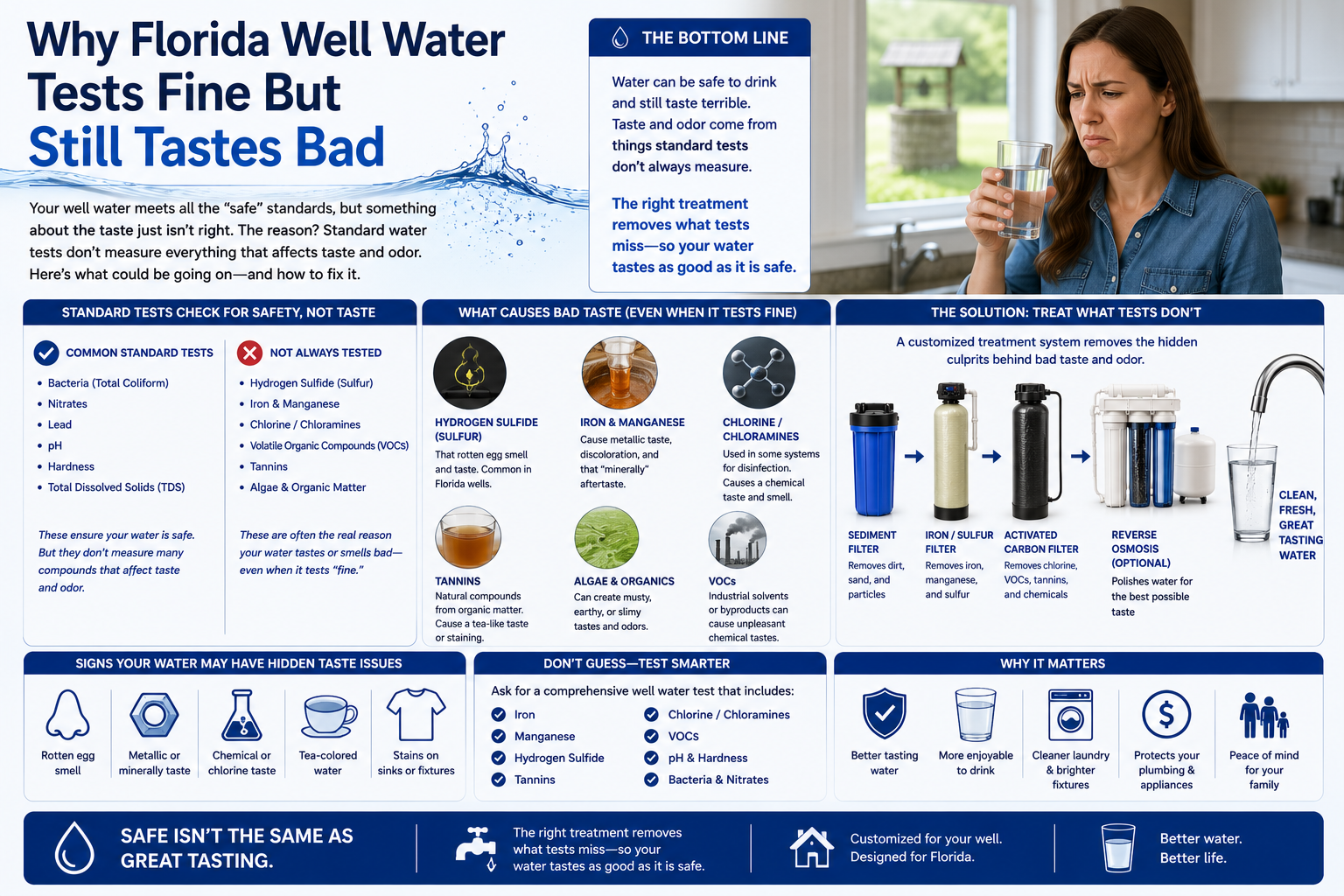
When most people get their well water tested — particularly through a home purchase inspection or a basic screening — the test is focused on safety parameters. A standard basic well water safety screen typically checks for:
- Coliform bacteria and E. coli
- Nitrates and nitrites
- pH
- A handful of regulated contaminants
These parameters matter enormously for health and safety. But they tell you almost nothing about how your water will taste, smell, or feel — because the compounds responsible for taste and odor problems are largely separate from the ones that make water unsafe.
A well water safety test that comes back clean is telling you one specific thing: your water doesn't contain dangerous levels of the specific contaminants on that particular panel. It is not telling you that your water tastes good, smells neutral, or is free of the minerals and compounds that affect daily quality of life.
What Basic Safety Tests Don't Measure
Here's where the gap between "tests fine" and "tastes fine" lives. The most common culprits behind bad-tasting Florida well water are frequently not included in a basic safety screen:
Hardness (calcium and magnesium). High mineral content gives water a flat, sometimes chalky taste that's distinctly different from the clean, neutral taste most people prefer. Florida well water is typically very hard — often 15 to 25+ grains per gallon — and that mineral load affects taste noticeably for many people, particularly in drinking water and beverages. A basic safety test usually doesn't include hardness.
Hydrogen sulfide at low concentrations. The rotten egg odor of hydrogen sulfide is detectable by most people at concentrations as low as 0.5 parts per million — well below any level that constitutes a safety concern. A basic safety test may not include hydrogen sulfide, or may only flag it at concentrations significantly higher than what affects taste and smell. As covered in our article on what sulfur water is and why it smells, even trace amounts of hydrogen sulfide produce a noticeable and unpleasant odor that most people find impossible to ignore.
Iron at lower concentrations. The EPA's secondary standard for iron — set based on taste and aesthetic concerns rather than health effects — is 0.3 parts per million. Water at or slightly above this threshold may not trigger a safety concern in a basic test but produces a distinct metallic taste and can contribute to staining. Many basic safety screens don't include iron, or don't flag it unless it's significantly above the aesthetic standard.
Manganese. Like iron, manganese at lower concentrations affects taste without necessarily appearing on a basic safety panel. It produces a bitter, slightly metallic taste and contributes to dark staining. For more on the difference between iron and manganese in well water, see our article on what distinguishes iron from manganese in Florida well water.
Tannins. Organic compounds from decomposing vegetation — common in shallow wells and wells near wooded areas in Florida — give water a tea-colored appearance and an earthy, slightly bitter taste. Tannins are not a health concern at typical concentrations in well water, which means they won't appear in a safety-focused test — but they're immediately noticeable in taste and appearance.
Total dissolved solids (TDS). The overall concentration of dissolved minerals and compounds in your water affects taste even when no individual compound is at a problematic level. High TDS water often tastes heavy or mineral-laden compared to lower TDS water. Basic safety tests don't include TDS as a standard parameter. As covered in our article on what TDS means for Florida homeowners, TDS is a useful indicator of overall water mineral content even when individual parameters are within acceptable ranges.
Carbon dioxide. Dissolved CO2 in well water can give it a slightly acidic, carbonated quality that affects taste. While not a safety concern, it contributes to the overall water character that many people find off-putting.
The Taste Threshold vs. The Safety Threshold
This is the fundamental distinction that explains why your water can test fine and still taste bad: the concentration at which something affects taste is often much lower than the concentration at which it becomes a safety concern.
Hydrogen sulfide is a perfect example. The odor detection threshold for most people is around 0.5 PPM. The level at which hydrogen sulfide becomes a health concern in drinking water is significantly higher. So you can have well water with enough hydrogen sulfide to smell unpleasant at every tap — and a basic safety test may not flag it at all.
The same principle applies to iron, manganese, and other minerals. The taste threshold and the safety threshold are different numbers — and a test designed to check safety thresholds tells you nothing about whether the water meets taste thresholds.
Florida's Geology and the Taste Problem
Florida's unique geology makes this issue particularly common. The Floridan Aquifer — the primary source for most Florida well water — runs through extensive limestone and organic-rich formations. Water drawn from this aquifer picks up calcium, magnesium, iron, manganese, hydrogen sulfide, and organic compounds along the way.
Many of these compounds exist at concentrations that are entirely safe to consume but immediately noticeable in taste and odor. Florida well water that's been declared safe by a basic test is often still carrying a complex mix of aesthetic contaminants that make it unpleasant to drink without treatment.
This is why Florida well water users who rely on a basic safety test — and conclude that their water is fine because nothing dangerous was detected — are often still dealing with water they don't enjoy drinking. The test answered the right question for safety; it just wasn't designed to answer the question about taste.
The Comprehensive Test: What Changes
A comprehensive water test — one that includes hardness, iron, manganese, hydrogen sulfide, tannins, TDS, and other aesthetic parameters alongside the safety parameters — gives you the full picture. It tells you not just whether your water is safe, but what's actually in it that affects how it tastes, smells, and behaves in your home.
With that complete picture, a treatment system can be designed to address both categories simultaneously — making the water safe where it needs safety treatment, and making it pleasant to drink and use where aesthetic treatment is needed.
As covered in our article on what the best well water treatment setup looks like, a properly designed well water system addresses the full range of parameters — not just the ones that appear on a basic safety screen.
What Treats Aesthetic Water Quality Problems
The treatment for aesthetic well water problems follows directly from what the comprehensive test reveals:
Hydrogen sulfide odor: Catalytic carbon filtration for lower concentrations; air injection oxidation for moderate to higher concentrations. As covered in our article on what sulfur water is, choosing the right approach depends on the concentration identified in the test.
Iron and manganese taste: Iron filtration — whether through air injection oxidation, greensand filtration, or other approaches — removes the metallic taste compounds before they reach your taps. Water softening addresses low to moderate dissolved iron alongside hardness.
Hardness and mineral taste: A water softener removes calcium and magnesium, significantly improving the taste of drinking water and eliminating the flat, mineral-laden quality that hard water produces.
Tannins: A specialized anion exchange tannin filter addresses the earthy taste and color that organic compounds produce in some Florida wells.
High TDS and overall mineral taste: For the cleanest possible drinking water — addressing the full range of dissolved solids — an under-sink reverse osmosis system at the kitchen tap produces water with very low TDS and excellent taste regardless of what the source water contains. As covered in our article on how reverse osmosis works, RO removes 90 to 99 percent of dissolved solids — producing water that rivals the best bottled water for taste and purity.
The Bottom Line
Well water that tests fine on a basic safety screen is safe — but safe and good-tasting are not the same standard, and a basic safety test isn't designed to tell you whether your water will taste the way you want it to. In Florida, where well water draws from mineral-rich aquifer formations and often carries hydrogen sulfide, iron, hardness, and organic compounds at concentrations well below safety thresholds but well above taste thresholds, this distinction matters every time you fill a glass of water.
A comprehensive water test gives you the full picture. Treatment based on that complete picture gives you water that isn't just safe — it's water you actually want to drink.
Dependable Water Treatment offers comprehensive well water testing for Florida homeowners — going beyond the basic safety screen to identify everything affecting your water's taste, odor, and quality. Contact us to schedule a water test and find out what's really in your well water.