You turn on your RO faucet expecting a steady stream of purified water, and instead you get a slow trickle — or worse, nothing at all after a few seconds. A slow-filling or slow-flowing reverse osmosis system is one of the most common issues homeowners encounter, and the good news is that most causes are straightforward to diagnose and fix without replacing the entire system.
How Your RO System Is Supposed to Work
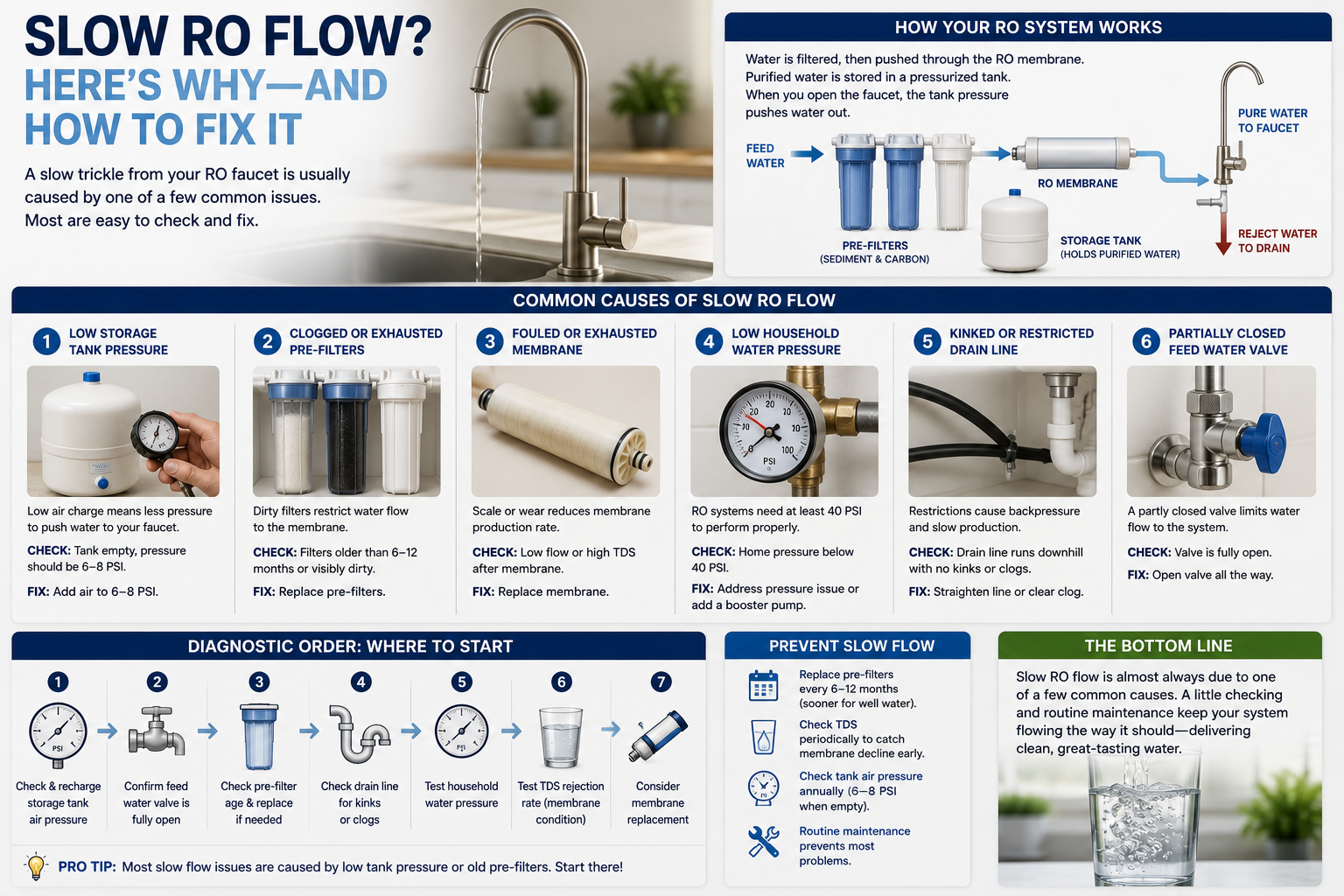
To understand why slow flow happens, it helps to remember how a residential RO system is designed to operate. As covered in our article on how reverse osmosis works, the RO membrane produces purified water slowly — often just a few gallons per hour — so that water is stored in a pressurized storage tank rather than produced on demand. When you open the RO faucet, you're drawing from that stored, pressurized supply, which should deliver a normal, steady flow rate.
Slow flow at the faucet typically means one of two things: either the storage tank isn't holding adequate pressure, or something upstream is restricting the flow of water into the system in the first place. Working through the possibilities systematically usually identifies the cause quickly.
The Most Common Cause: Low Storage Tank Pressure
The RO storage tank contains a rubber bladder, with compressed air on one side and stored water on the other. As the tank fills with purified water, the air on the other side of the bladder compresses, building pressure that pushes water out when you open the faucet. Over time, that air charge can leak out or diminish, reducing the tank's ability to push water out at a normal flow rate — even if the tank is completely full of water.
This is by far the most common cause of a slow-filling or slow-flowing RO faucet, and it's also one of the easiest to check and fix.
How to check tank pressure: With the tank empty or nearly empty (run the RO faucet until flow essentially stops), locate the air valve on the tank — typically a Schrader valve similar to what you'd find on a bicycle or car tire, usually located at the bottom or side of the tank. Using a standard tire pressure gauge, check the air pressure. It should read approximately 6 to 8 PSI when the tank is empty of water. If the pressure is significantly below this — even just a few PSI — the tank isn't providing adequate push to deliver water at a normal flow rate.
How to fix it: Using a bicycle pump or small air compressor, add air through the Schrader valve until it reaches the manufacturer's recommended pressure — check your system documentation, but 7 PSI is a common target for standard residential RO tanks. This is a simple, inexpensive fix that resolves the majority of slow-flow RO complaints.
If the tank won't hold air pressure at all — losing it quickly after you add it — the bladder itself may have failed, which typically means tank replacement rather than a simple recharge.
Clogged or Exhausted Pre-Filters
Your RO system's sediment and carbon pre-filters protect the membrane, but they also restrict flow as they become loaded with contaminants over their service life. A pre-filter that's well past its replacement interval can significantly reduce the flow of water reaching the membrane in the first place — meaning the membrane produces purified water more slowly, the tank fills more slowly, and your faucet flow suffers as a result.
Florida's water — often higher in sediment, iron, and mineral content than many other regions — can load pre-filters faster than the standard replacement interval assumes, particularly for well water users. As covered in our article on how long water treatment systems last, RO pre-filters typically need replacement every 6 to 12 months — but in Florida, replacement at the shorter end of that range, or even more frequently for well water with significant sediment or iron, may be necessary to maintain proper flow.
If your system's flow has been gradually declining over several months rather than suddenly, exhausted pre-filters are a likely culprit worth checking before assuming something more serious is wrong.
A Fouled or Exhausted Membrane
The RO membrane itself can become fouled with scale, particularly in Florida's hard water areas, or simply reach the end of its effective service life. A fouled or worn membrane produces purified water at a reduced rate, directly slowing how quickly your storage tank fills.
As covered in our article on what TDS means for Florida homeowners, testing TDS before and after the membrane tells you its rejection rate — but a declining flow rate, even with rejection still reasonably good, can indicate the membrane surface is becoming scaled or fouled and needs replacement. In Florida, where source water is often quite hard, membrane scaling is a more common issue than in areas with softer municipal water — another reason why pairing an RO system with upstream water softening, as covered in our article on why some Florida homes need both a softener and carbon filter, extends membrane life and helps maintain consistent flow rate over time.
Low Household Water Pressure
RO systems are designed to operate within a specific incoming water pressure range — typically a minimum of 40 PSI is recommended for most residential systems to achieve their rated production rate. If your home's water pressure is below this threshold, your RO system will produce water more slowly regardless of how well-maintained the filters and membrane are.
This is worth checking if slow RO flow is a persistent issue rather than something that developed gradually. A simple pressure gauge attached to an outdoor spigot or a washing machine connection can tell you your home's general water pressure. If it's consistently low throughout your home — not just at the RO faucet — the underlying cause may be a household pressure issue rather than anything specific to the RO system itself. As covered in our article on why water pressure may be dropping over time, several factors can contribute to declining household pressure that would affect RO performance along with everything else.
Some RO systems can be paired with a small booster pump specifically to address low incoming pressure situations, ensuring the membrane receives adequate pressure to operate efficiently even when household pressure is on the lower side.
A Kinked or Restricted Drain Line
RO systems require a drain connection to carry away the reject water — the concentrated water that doesn't pass through the membrane. If this drain line is kinked, clogged, or improperly installed, it can create backpressure that affects the membrane's ability to produce water efficiently, indirectly slowing tank fill rate.
Check that the drain line runs without sharp bends or pinches, and that the drain saddle connection (where the RO drain line ties into your sink's drain plumbing) isn't clogged or positioned in a way that creates a restriction.
A Closed or Partially Closed Feed Water Valve
The feed water valve — typically a small valve on the cold water line under your sink where the RO system taps into your home's plumbing — needs to be fully open for the system to receive adequate water flow. If this valve was partially closed during installation, maintenance, or an unrelated plumbing project, it can bottleneck the entire system's performance. This is a simple thing to verify and correct.
Diagnostic Order: Where to Start
If your RO system is filling slowly, working through these checks in order typically identifies the cause efficiently:
- Check and recharge the storage tank air pressure — the most common and easiest fix
- Confirm the feed water valve is fully open
- Check pre-filter age and replace if due or overdue
- Check the drain line for kinks or clogs
- Test household water pressure if the issue persists
- Test TDS rejection rate to evaluate membrane condition
- If all else checks out, consider membrane replacement
Preventing Slow Flow Going Forward
Staying on top of routine RO maintenance is the most effective way to prevent slow-flow issues before they start. This means replacing pre-filters on schedule, monitoring TDS periodically to catch membrane decline early, and checking tank air pressure annually as part of routine system maintenance — even if flow seems fine, since a slowly declining tank charge can be easy to miss until it becomes a noticeable problem.
The Bottom Line
Slow RO flow is almost always traceable to one of a handful of common causes — most frequently low storage tank pressure, followed by pre-filter exhaustion, membrane fouling, or household pressure issues. Working through the diagnostic checklist above resolves the vast majority of cases without needing to replace the entire system, and staying current on routine maintenance prevents most of these issues from developing in the first place.
Having trouble with your RO system's flow rate? Dependable Water Treatment services and maintains reverse osmosis systems for Florida homeowners. Contact us for a diagnostic visit or routine maintenance service.