If you've replaced a faucet, shower valve, toilet fill valve, or other plumbing fixture more than once in what seems like a short period of time — and the replacements keep failing ahead of schedule too — your water is almost certainly the reason. Plumbing fixtures are designed to last many years under normal conditions. In Florida, where hard water and chemical disinfectants are the norm, "normal conditions" is rarely what fixtures actually experience.
Understanding why fixtures fail prematurely — and what's driving that failure — is the key to stopping the replacement cycle for good.
What Plumbing Fixtures Are Actually Made Of
Modern plumbing fixtures contain a mix of materials — brass bodies, chrome or nickel plating on the exterior, rubber O-rings and washers, ceramic disc cartridges, plastic components, and spring mechanisms. Each of these materials interacts with your water differently, and hard water and chemical disinfectants affect each one in ways that accelerate wear and failure.
Understanding what's inside your fixtures helps explain why they fail — and why the failure patterns are so consistent in Florida homes with untreated water.
How Hard Water Destroys Fixtures From the Outside In
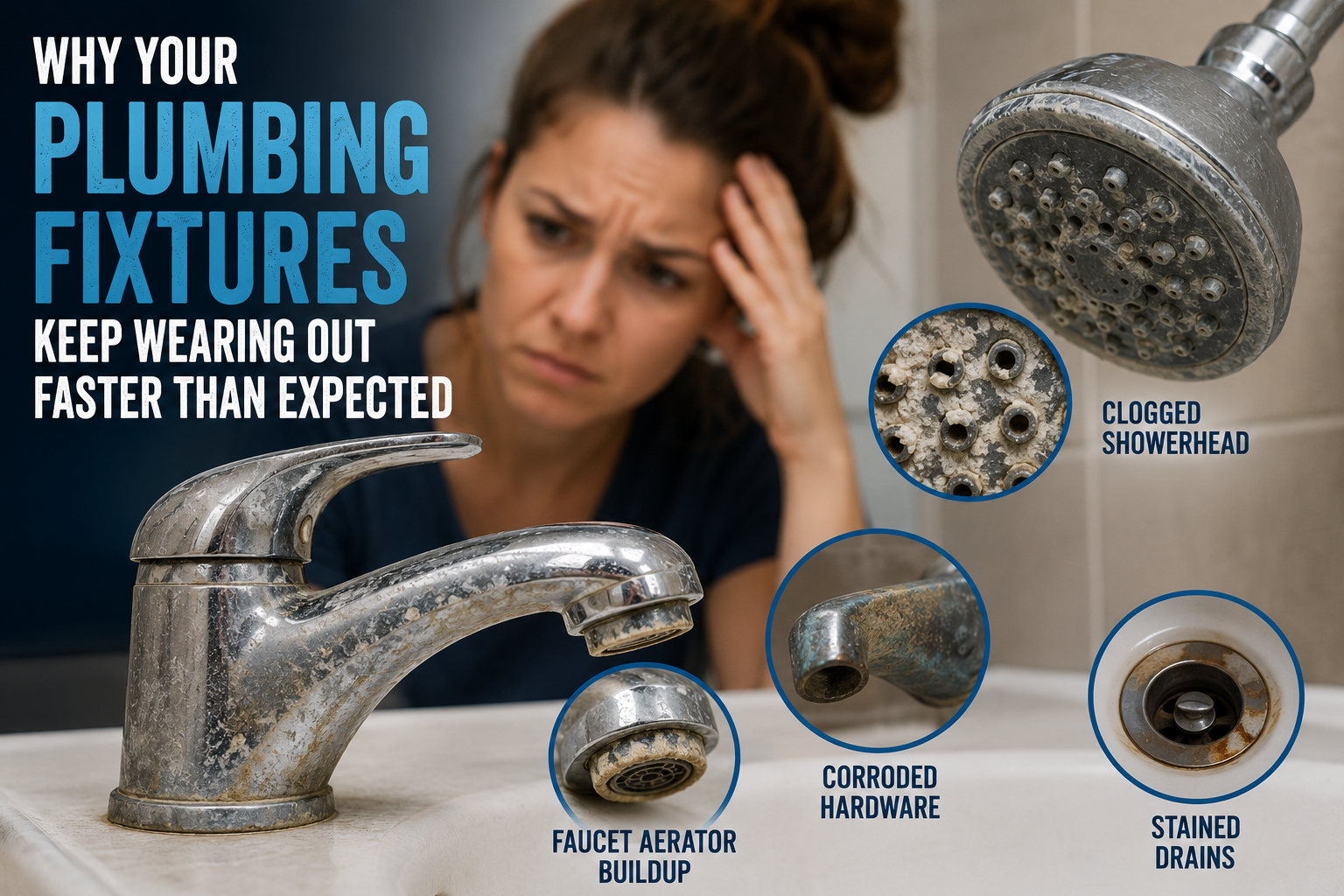
The white, chalky buildup you see on the outside of your faucets and showerheads is the most visible effect of hard water on fixtures — but it's not the most damaging one. That buildup is calcium carbonate scale depositing on exterior surfaces as water evaporates. It's unsightly and difficult to remove, but it's primarily a cosmetic problem at the exterior.
The real damage happens inside the fixture, where scale accumulates on moving parts, valve seats, and the small passages water flows through. As covered in our article on why water pressure drops over time, scale narrows the internal passages of fixtures just as it narrows the interior of pipes — reducing flow and increasing the pressure differential across the fixture's internal components.
Scale on valve seats prevents a complete seal, causing faucets to drip even when fully closed. Scale on cartridge mechanisms causes them to bind and wear unevenly. Scale inside showerhead bodies causes spray patterns to become erratic and eventually blocks flow entirely. Scale on toilet fill valve components causes them to stick, run continuously, or fail to shut off properly.
Each of these failure modes produces the same outcome: a fixture that needs repair or replacement — often well before its designed lifespan.
How Hard Water Destroys Fixtures From the Inside Out
Beyond mechanical scale accumulation, hard water attacks the rubber components inside your fixtures — the O-rings, washers, and seals that create watertight connections and control water flow.
Calcium and magnesium in hard water interact with rubber over time, causing it to harden, crack, and lose its flexibility. A rubber washer that's designed to compress and create a seal becomes brittle and fails to seal properly. O-rings that should flex to accommodate pressure changes crack and leak. The harder your water, the faster this degradation process occurs.
This is why fixture repairs often require replacing multiple rubber components — and why the same fixtures keep failing in the same ways in homes with untreated hard water. The replacements go into the same water and experience the same degradation.
How Chloramines Make It Worse
For Florida homeowners on municipal water, hard water isn't the only fixture threat. Chloramines — the chemical disinfectants that many Florida utilities use in place of chlorine — are significantly more aggressive toward rubber and plastic components than chlorine alone.
As covered in our article on what chloramine is and why it's in Florida water, chloramines degrade rubber seals, O-rings, gaskets, and certain plastics through a chemical attack that chlorine causes more slowly. Fixtures in homes with chloraminated municipal water experience rubber degradation significantly faster than in areas using free chlorine.
This is why newer fixtures — which often use more plastic and rubber components than older all-brass designs — can fail surprisingly quickly in Florida municipal water homes. The materials are being attacked chemically by the disinfectant in the water, not just mechanically by the minerals.
Acidic Water: The Corrosion Factor
For some Florida well water homes, low pH — acidic water — adds a third failure mechanism to the mix. As covered in our article on why water pH matters for your home, acidic water is corrosive to metal components. It slowly dissolves brass and copper from fixture bodies and fittings, causing pitting, thinning of metal walls, and eventual structural failure.
The blue-green staining you might see in sinks and tubs is copper leaching from corroded pipes and fixtures — a visible indicator that acidic water is actively attacking your plumbing system. Fixtures in an acidic water home don't just wear out their rubber components — their metal bodies corrode from the inside, creating pinhole leaks and structural failures that no amount of washer replacement will fix.
Fixtures That Fail Most Commonly From Water Quality Issues
Faucet cartridges and valves. Ceramic disc cartridges — the most common type in modern faucets — are relatively resistant to scale but vulnerable to hard particles and debris. Conventional rubber washer faucets are highly vulnerable to rubber degradation from hard water and chloramines. Either type fails faster in Florida's water conditions than in softer, less chemically aggressive water.
Shower valves and diverters. The mixing valve inside your shower wall controls temperature by balancing hot and cold water flow. Scale accumulation and rubber degradation affect the valve's ability to maintain consistent temperature and to shut off completely. A shower that's hard to temperature-control or that drips after being turned off is often a valve showing the effects of water quality.
Toilet fill valves and flappers. Toilet fill valves contain numerous small rubber components that are in constant contact with your water. Scale buildup causes sticking and inconsistent shutoff. Chloramine degradation causes rubber flappers to warp and fail to seal, producing the constantly running toilet that wastes water and drives up your utility bill. Toilet flappers in Florida municipal water homes often need replacement every one to two years — a fraction of their designed lifespan.
Showerheads. As covered in our article on why showerheads keep clogging in Florida, scale accumulation in the spray holes and internal passages of showerheads is one of the most common and visible effects of hard water. Showerheads in hard water homes without treatment often need replacement every one to three years rather than the five to ten years they're designed to last.
Angle stops and supply valves. The shutoff valves under your sinks and behind your toilets are supposed to last the life of the home. In hard water homes with mineral accumulation and rubber degradation, these valves seize up from scale, fail to close completely, or develop leaks at seals and packing. A shutoff valve that won't close during a plumbing emergency is a serious problem — and one that hard water accelerates.
The Cumulative Cost of Premature Fixture Failure
Individual fixture replacements don't seem like much — a faucet cartridge here, a toilet flapper there. But add up the fixture replacements across an entire home over the years, and the cumulative cost becomes significant. Multiply that by the plumber's service calls when those failures cause leaks, water damage, or plumbing emergencies, and the financial picture becomes even clearer.
Hard water and chloramines aren't just an inconvenience for your fixtures — they're an ongoing expense that compounds quietly over time, the same way they compound for your appliances and your plumbing system as a whole. As covered in our article on what happens if you never treat hard water, these costs accumulate whether you notice them or not.
What Protects Your Fixtures
The protection strategy mirrors the failure mechanisms:
A water softener removes the calcium and magnesium that form scale inside fixtures and degrade rubber components. Soft water doesn't deposit scale on valve seats, doesn't narrow internal passages, and doesn't harden rubber O-rings and washers the way hard water does. Fixtures in soft water homes reach their designed lifespan routinely rather than failing years early.
A whole-house carbon filter removes chloramines before they reach your fixtures, eliminating the chemical attack on rubber and plastic components that accelerates failure in municipal water homes. For Florida homeowners on city water, carbon filtration upstream of every fixture in the home addresses a failure mechanism that a water softener alone doesn't cover. For more on this combination, see our article on why some Florida homes need both a softener and carbon filter.
pH correction for acidic well water stops the corrosive attack on metal fixture bodies and pipe walls, addressing the third failure mechanism in well water homes where low pH is a factor.
The Bottom Line
Your plumbing fixtures aren't failing because they're low quality or because you're unlucky. They're failing because Florida's water — hard, chemically treated, and in some cases acidic — attacks the rubber, metal, and plastic components inside them through multiple mechanisms simultaneously.
The replacement cycle you've been experiencing isn't inevitable. It's the predictable result of untreated water, and it stops when the water is properly treated. A water softener and carbon filter don't just improve your daily water experience — they protect every fixture in your home from the inside out, letting them reach the lifespan they were actually designed for.
Dependable Water Treatment helps Florida homeowners protect their plumbing fixtures and appliances with water softeners, carbon filters, and whole-home treatment systems. Contact us to schedule a water test and find out what your water is doing to your home.